IELTS · Artículos · 19 de octubre de 2026 · 9 min de lectura
IELTS Speaking Part 1: 16 preguntas frecuentes con respuestas de ejemplo
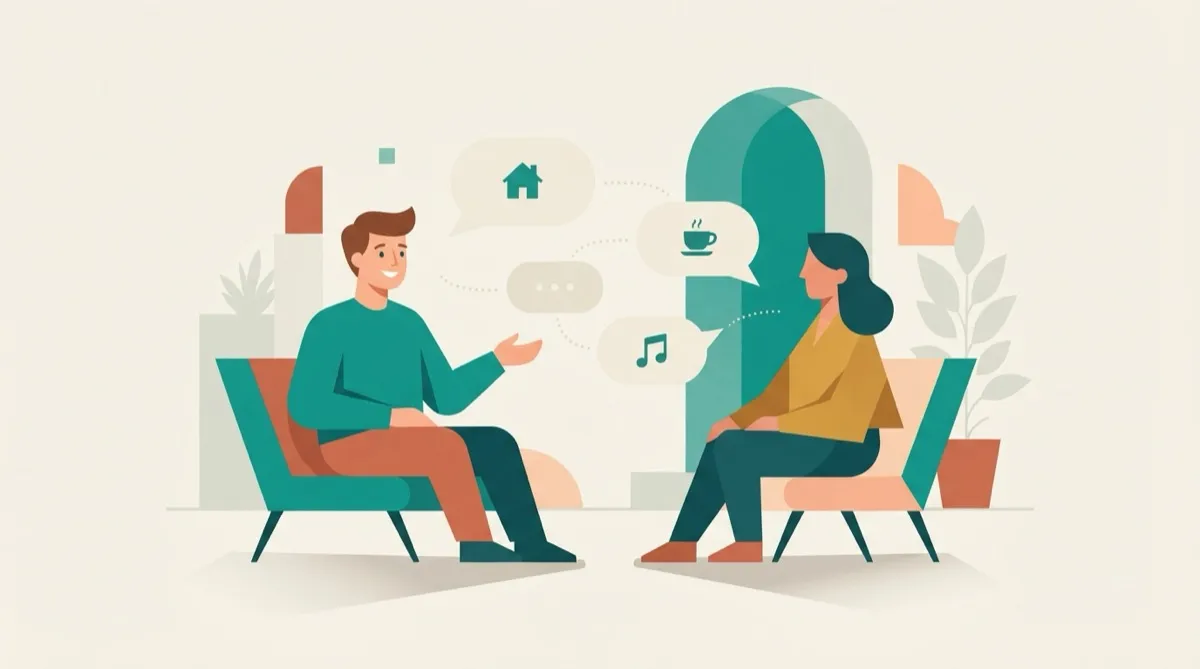
Part 1 son los primeros 4–5 minutos de IELTS Speaking. El examinador comprueba tu documentación, te pregunta el nombre y pasa a preguntas sencillas sobre ti: dónde vives, en qué trabajas o qué estudias, qué te gusta comer, cómo pasas los fines de semana.
Es un calentamiento, y por eso se subestima. Las preguntas son fáciles, así que la mayoría responde demasiado corto. Pero la nota empieza a formarse desde el primer minuto.
Cómo funciona Part 1
El examinador elige 2–3 temas y hace 3–4 preguntas de cada uno. Son temas personales y previsibles: trabajo, estudios, casa, ciudad natal, aficiones, comida, tiempo, transporte, redes sociales.
No hay tiempo de preparación: oyes la pregunta y respondes. Tampoco hace falta, porque todas las respuestas tratan de ti.
La fórmula de respuesta
El mayor error de Part 1 es responder con una palabra. Decir Yes a Do you like cooking? no muestra ni fluidez ni vocabulario.
Usa tres pasos:
- Respuesta: contesta directamente.
- Motivo: di por qué.
- Detalle: un ejemplo, un contraste o una precisión.
Salen 2–4 frases, 15–20 segundos. En Part 1 no hace falta más: el examinador tiene que pasar por varios temas.
Otro recurso: evita el sí o no a secas. It depends on…, For the most part, yes o I’d say… suenan más naturales y muestran inglés hablado real.
Trabajo y estudios
Do you work, or are you a student?
I’m currently working as a marketing specialist at a small tech company. I’ve been there for just over two years now, and although it can get pretty hectic, I genuinely enjoy the creative side of the job. Before this, I studied business management at university, so what I do now is quite closely related to my degree.
- currently: actualmente (más natural que now);
- it can get pretty hectic: a veces es una locura (más vivo que busy);
- although…: oración concesiva, suma en gramática;
- closely related to: muy relacionado con.
Do you enjoy your job?
For the most part, yes. What I enjoy most is that no two days are the same, so I never get bored. The deadlines can be stressful, I won’t lie, but the sense of achievement when a project comes together makes up for it. I’d say the pros definitely outweigh the cons.
- for the most part: en general;
- no two days are the same: no hay dos días iguales;
- makes up for it: lo compensa;
- the pros outweigh the cons: las ventajas pesan más que los inconvenientes.
Casa y ciudad natal
Do you live in a house or a flat?
I live in a fairly small flat on the outskirts of the city. It’s nothing fancy, but it’s cosy and it’s got everything I need. I’ve been renting it with a friend for a couple of years now, and what I like most is how quiet the area is, especially after a long day at work.
- on the outskirts: en las afueras (más preciso que far from the centre);
- nothing fancy: nada del otro mundo;
- cosy: acogedor;
- what I like most is…: una buena forma de introducir un detalle.
Can you describe your hometown?
I’m from a mid-sized city in the south of the country. It’s not particularly famous, but it has a really laid-back atmosphere and some beautiful old architecture in the centre. The one downside is that job opportunities are fairly limited, which is why a lot of young people move to bigger cities.
- mid-sized: de tamaño medio;
- laid-back atmosphere: ambiente tranquilo;
- the one downside is: el único inconveniente es;
- which is why…: por eso (une causa y consecuencia).
El esquema «lo bueno y lo malo» funciona muy bien: la respuesta suena equilibrada y te da un motivo natural para seguir hablando.
Tiempo libre
What do you do in your free time?
In my free time, I usually try to unwind by doing something active, like going for a run or playing tennis with friends. I find that exercise really helps me clear my head after a long day. On lazier days, though, I’ll happily curl up with a good book or binge-watch a series.
- unwind: desconectar (más preciso que relax);
- clear my head: despejar la mente;
- curl up with a book: acurrucarse con un libro;
- binge-watch: ver una serie de un tirón.
How do you usually spend your weekends?
My weekends tend to be a mix of catching up on chores and seeing friends. On Saturdays I usually run errands and tidy up the flat, and then Sundays are more about relaxing, maybe meeting up with friends for brunch. I always try to strike a balance between being productive and actually resting.
- catch up on chores: ponerse al día con las tareas de casa;
- run errands: hacer recados;
- meet up with friends: quedar con amigos;
- strike a balance: encontrar el equilibrio.
La estructura «sábado / domingo» es un esquema listo para cualquier pregunta sobre rutinas.
Do you like reading?
I do, although I wish I had more time for it. I’m mostly into non-fiction, things like popular science and biographies, because I like learning something new. I tend to read in the evenings to wind down before bed, and lately I’ve been getting through about a book a month, which isn’t bad given how busy things are.
- I wish I had more time: ojalá tuviera más tiempo (estructura hipotética, suma en gramática);
- I’m into: me interesa, me gusta;
- wind down: relajarse antes de dormir;
- get through a book: terminar un libro.
What kind of music do you like?
My taste in music is pretty varied, but I tend to gravitate towards indie and a bit of jazz. It really depends on my mood, to be honest. When I’m working, I’ll put on something instrumental, but on a night out, I’m all for upbeat pop. Music is a big part of my daily routine.
- my taste is varied: tengo gustos variados;
- gravitate towards: tender hacia;
- it depends on my mood: depende de mi estado de ánimo;
- I’m all for: me encanta, estoy a favor.
Comida
What is your favourite food?
That’s a tough one, because I’m a bit of a foodie. But if I had to choose, I’d probably go with Italian, pasta in particular. There’s just something really comforting about a good homemade carbonara. I’m not much of a cook myself, though, so I usually leave it to the professionals.
- a bit of a foodie: amante de la buena comida;
- if I had to choose: si tuviera que elegir (útil cuando cuesta quedarse con una cosa);
- comforting: reconfortante;
- not much of a cook: no se me da muy bien cocinar.
Do you like cooking?
I’d say I enjoy it more than I used to. I’m no chef, but I can put together a few decent meals, and I find it quite relaxing after work. During the week I keep things simple, but at weekends I like experimenting with new recipes, usually something I’ve come across online.
- more than I used to: más que antes (used to muestra un cambio en el tiempo);
- I’m no chef: no soy ningún chef;
- put together a meal: preparar una comida;
- come across: encontrarse con algo por casualidad.
Compras, redes sociales y fotos
Do you enjoy shopping?
It depends on what I’m shopping for, really. I quite enjoy browsing for things like books or gadgets, but I find clothes shopping a bit of a chore. These days I do most of it online anyway, it saves so much time, although I do miss being able to try things on before I buy them.
- it depends on: depende de;
- browsing: mirar sin intención fija de comprar;
- a bit of a chore: un poco pesado;
- try things on: probarse la ropa.
Do you use social media a lot?
Probably more than I’d like to admit, to be honest. I mainly use it to keep in touch with friends and to follow a few accounts related to my work. That said, I’ve been trying to cut down recently, because it’s so easy to lose track of time scrolling. I think it’s all about using it in moderation.
- more than I’d like to admit: más de lo que me gustaría reconocer;
- keep in touch: mantener el contacto;
- cut down: reducir;
- in moderation: con moderación.
Do you like taking photos?
Yeah, I take photos all the time, mostly just on my phone. I’m not a serious photographer or anything, but I love capturing little everyday moments, especially when I’m travelling. Looking back at old photos is one of my favourite things, it brings back so many memories I’d otherwise forget.
- all the time: constantemente;
- capture moments: captar momentos;
- bring back memories: traer recuerdos;
- I’d otherwise forget: que, si no, olvidaría (estructura condicional).
Rutina, tiempo y transporte
Are you a morning person or a night owl?
Definitely a night owl, I’ve never been much good in the mornings. I tend to be most productive late in the evening, when it’s quiet and there are no distractions. Mornings are a bit of a struggle, to be honest, I usually need a coffee or two before I feel properly awake.
- a night owl: ave nocturna, alguien que rinde de noche;
- most productive: cuando más rindo;
- a bit of a struggle: me cuesta;
- properly awake: con la cabeza ya despejada.
What’s the weather like in your country?
We get quite distinct seasons where I’m from. Winters can be pretty harsh, with a lot of snow, while summers are warm and fairly short. Personally, I’m more of an autumn person, I love that crisp, cool air and the colours. The only thing I can’t stand is the grey, damp weather we sometimes get in spring.
- distinct seasons: estaciones muy marcadas;
- harsh: duro (más fuerte que cold);
- I’m more of an autumn person: prefiero el otoño;
- can’t stand: no soporto.
How do you usually get around your city?
I mostly rely on public transport, the metro in particular, since it’s by far the quickest way to get around during rush hour. Occasionally I’ll walk if it’s somewhere nearby, because I like getting a bit of fresh air. I’m not a big fan of driving here, to be honest, the traffic can be a nightmare.
- rely on: depender de;
- by far the quickest: con diferencia lo más rápido (superlativo reforzado);
- rush hour: hora punta;
- a nightmare: una pesadilla.
Qué sube la nota en Part 1
Si relees las respuestas, verás cuatro recursos que se repiten:
Matizar en lugar de responder a secas. It depends on…, For the most part, I’d say, to be honest. El discurso suena natural, no ensayado.
Phrasal verbs. Cut down, wind down, come across, get through, meet up with. Son una señal clara para Lexical Resource y encajan solos en temas cotidianos.
Variedad de tiempos verbales. I’ve been renting, I used to, I wish I had, I’d otherwise forget. Es Grammatical Range, que baja si todo va en presente simple.
Contraste. …but, That said, The one downside is, although. Te da un motivo natural para una segunda frase, así no te quedas en blanco.
Cómo practicar
No memorices respuestas palabra por palabra. Los examinadores lo notan: el discurso ensayado suena demasiado pulido y se desmorona con la primera pregunta de seguimiento. Toma de los ejemplos el vocabulario y la estructura, y pon tus propios datos.
Un método práctico: responde en voz alta a las 16 preguntas con tu información, usando 2–3 expresiones de las notas en cada una. Repite al día siguiente: lo que te salga solo es tu vocabulario activo.
Después: Part 2, donde hablas dos minutos a partir de una tarjeta, y Part 3, un debate sobre temas generales. En la zona de práctica de Nomto puedes responder Part 1 en voz alta y recibir una nota con los cuatro criterios y corrección.