IELTS · Articles · October 19, 2026 · 3 min read
IELTS test format: the four sections, timing and scoring
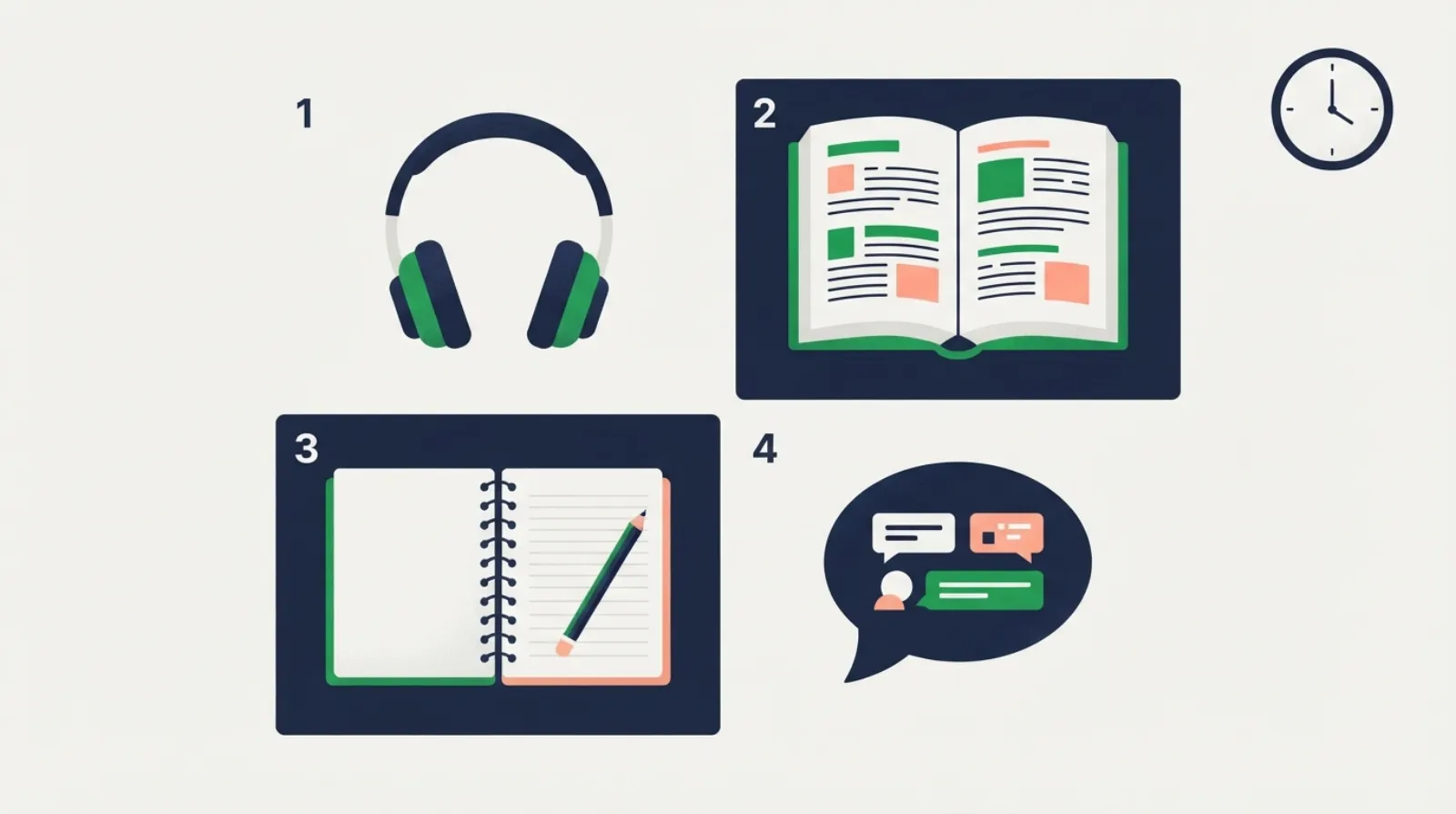
IELTS (International English Language Testing System) checks four skills: Listening, Reading, Writing and Speaking. The whole test takes about 2 hours 45 minutes. Listening, Reading and Writing are done in one sitting, with no breaks between them. Speaking is a separate face-to-face interview with an examiner, on the same day or within about a week of the other three.
Each section gets a band from 0 to 9 in half bands, and the four bands make your overall score.
The test at a glance
| Section | Time | What you do | Questions |
|---|---|---|---|
| Listening | about 30 minutes | Four recordings: two everyday, two academic | 40 |
| Reading | 60 minutes | Three texts (Academic) or several shorter texts (General Training) | 40 |
| Writing | 60 minutes | Task 1 (150+ words) and Task 2, an essay (250+ words) | 2 tasks |
| Speaking | 11–14 minutes | A three-part interview with an examiner | 3 parts |
Listening
You hear four recordings, each played once. Part 1 is an everyday conversation (booking a room, joining a club), Part 2 is a monologue on an everyday topic, Part 3 is a discussion in an academic setting and Part 4 is a short lecture. The parts get harder as you go.
Question types include form and table completion, multiple choice, matching and labelling a map or plan. Spelling counts: a correct word spelled wrongly is a wrong answer.
You type your answers as you listen and get 2 minutes at the end to check them.
Reading
Sixty minutes, three sections, 40 questions. There is no extra time at the end, so enter each answer as you go.
- Academic: three long texts from books, journals, magazines and newspapers.
- General Training: shorter texts from everyday life and work (notices, adverts, workplace documents), then one longer text.
Common tasks are True / False / Not Given, matching headings, sentence completion and multiple choice. The True / False / Not Given guide explains the type that costs learners the most marks.
Writing
Sixty minutes for two tasks.
- Task 1, at least 150 words, about 20 minutes. Academic: describe a chart, table, map or process. General Training: write a letter (formal, semi-formal or informal).
- Task 2, at least 250 words, about 40 minutes. An essay in response to a point of view, an argument or a problem. It is the same type of task in both versions.
Task 2 counts twice as much as Task 1, so it deserves more of your time. Both tasks are marked on four criteria: how fully you answer the task, how well the text is organised, vocabulary, and grammar. See how to structure a Task 2 essay.
Speaking
A recorded conversation with an examiner, 11 to 14 minutes:
- Part 1 (4–5 minutes): short questions about familiar topics such as home, work, studies and hobbies.
- Part 2 (3–4 minutes): you get a card with a topic, have one minute to prepare and then speak for up to two minutes. More in the Part 2 guide.
- Part 3 (4–5 minutes): a discussion of more abstract questions linked to the Part 2 topic.
The examiner rates fluency and coherence, vocabulary, grammar and pronunciation, a quarter each.
Academic or General Training
Listening and Speaking are identical in both versions. Reading and Writing Task 1 differ. Academic is for university study and professional registration; General Training is mostly for work and migration. The full comparison is in IELTS Academic vs General Training.
On computer, at a test centre
Since mid-2026 IELTS has been delivered on computer only; the paper-based test has been withdrawn, with the last paper dates varying by country. Some markets offer a “Writing on Paper” option, where only the essays are handwritten. Results usually arrive in 1–5 days, most often in 1–2. Speaking is still a live interview with an examiner. Some countries also offer IELTS Online, taken at home with a remote invigilator, but not every organisation accepts it, so check first.
What this means for preparation
Every section has a fixed time, so practise under the same limits: 20 and 40 minutes for writing, one minute of preparation for Speaking Part 2, one hour for three reading texts. Most of the score that learners lose comes from timing and task format rather than from a lack of English.