IELTS · Articles · October 20, 2026 · 5 min read
PTE vs IELTS in 2026: differences and the official PTE to IELTS score conversion
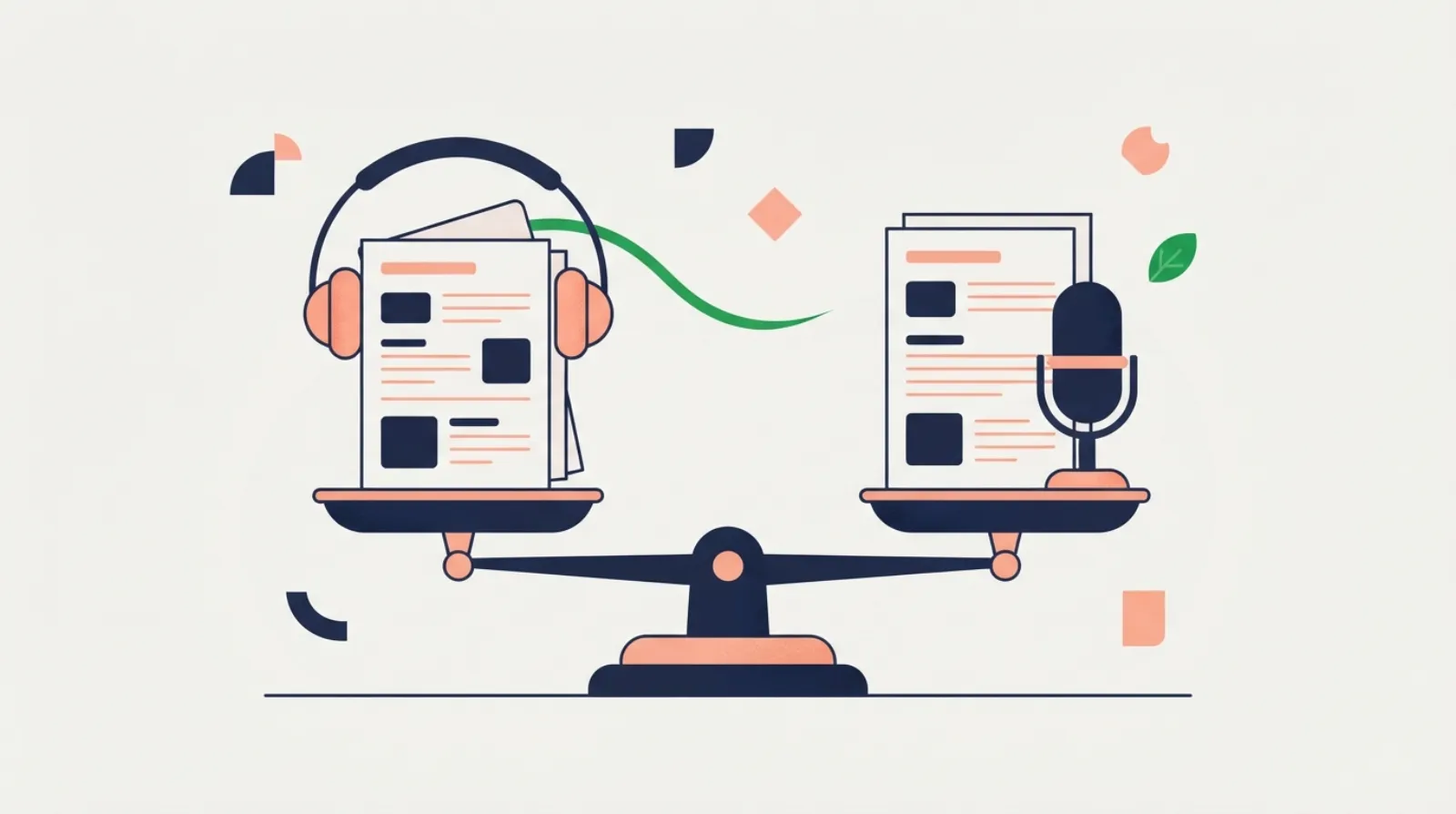
PTE Academic and IELTS Academic measure the same four skills and are accepted by most universities and by the visa authorities of Australia, New Zealand and the UK. The difference is in how the test is run: PTE is about two hours on a computer and is marked by an automated system; IELTS takes about 2 hours 45 minutes and includes a live conversation with an examiner.
PTE and IELTS side by side
| PTE Academic | IELTS Academic | |
|---|---|---|
| Run by | Pearson | British Council, IDP and Cambridge University Press & Assessment |
| Length | about 2 hours | about 2 hours 45 minutes |
| Speaking | recorded into a microphone, mixed with the other skills | 11–14 minutes, face to face with an examiner |
| Marking | automated scoring, with some answers checked by human experts | examiners for Speaking and Writing, answer key for Listening and Reading |
| Scale | 10 to 90 | 0 to 9 in half bands |
| Results | typically within 48 hours | 1–5 days on computer |
| Versions | PTE Academic, PTE Academic UKVI, PTE Core for Canada | Academic, General Training, IELTS for UKVI |
Data from pearsonpte.com and ielts.org as of October 2026. Fees depend on the country; in India, for example, IELTS costs ₹19,000 (see the IELTS exam fee in India).
PTE to IELTS score conversion: the official table
Pearson updated its concordance with IELTS in July 2025, based on a study of the updated PTE Academic test carried out with CRELLA at the University of Bedfordshire. The table shows the minimum PTE score that corresponds to each IELTS band.
| IELTS band | Minimum PTE Academic score |
|---|---|
| 4.5 | 24 |
| 5.0 | 31 |
| 5.5 | 39 |
| 6.0 | 47 |
| 6.5 | 55 |
| 7.0 | 63 |
| 7.5 | 71 |
| 8.0 | 79 |
| 8.5 | 86 |
| 9.0 | 90 |
Source: Pearson, “PTE Academic scoring”, pearsonpte.com, checked on 20 October 2026.
So a PTE score of 58 sits in the IELTS 6.5 range (55–62), and 65 sits in the 7.0 range (63–70). Charts on many prep sites still show the older figures, where 65 was needed for 7.0. If a chart has no date and no source, do not trust it.
The IELTS side does not fully agree
The IELTS Partners ran their own study and publish a different table on ielts.org. It gives the average PTE score of people who reached each IELTS band, not a minimum:
| IELTS band | Average PTE Academic score |
|---|---|
| 5.0 | 40.8 |
| 5.5 | 45.4 |
| 6.0 | 51.6 |
| 6.5 | 58.5 |
| 7.0 | 66.3 |
| 7.5 | 74.6 |
| 8.0 | 82.3 |
| 8.5 | 88.1 |
Source: ielts.org, “Understanding how IELTS compares to other tests”, checked on 20 October 2026.
The two tables answer different questions and should not be mixed. In practice, neither of them decides your admission: a university or visa programme sets its own minimum for each test. Read the requirement for PTE and the requirement for IELTS separately, and aim for the one that is listed.
How the tests feel different
- Speaking. In IELTS you talk to a person for 11–14 minutes: questions about you, a two-minute talk from a card, then a discussion. In PTE you speak to a computer in short bursts: read a text aloud, repeat a sentence, describe an image, retell a lecture. Some people find the microphone less stressful; others find the time limits and the lack of a listener harder.
- Integrated tasks. PTE often scores several skills from one task. Repeating a sentence, for example, counts towards both listening and speaking. In IELTS each section is scored separately.
- Writing. IELTS has two tasks in 60 minutes: a chart, map or process (or a letter in General Training) and an essay of at least 250 words. PTE has shorter writing tasks, including summarising a text in one sentence and an essay.
- Pronunciation and fluency. Both tests reward clear speech. In PTE the automated scoring is strict about hesitations and long pauses inside a timed response; in IELTS the examiner judges how easy you are to understand. See IELTS pronunciation for what the examiner listens for.
Which one to choose
- Australia and New Zealand. Both tests are accepted for visas. The required scores changed in recent years, so check the current table on the Department of Home Affairs or Immigration New Zealand site, not a prep blog.
- Canada. For permanent residence and citizenship IRCC accepts IELTS General Training and PTE Core, not PTE Academic. For study, most institutions accept both.
- UK. For many visas you need a Secure English Language Test: IELTS for UKVI or PTE Academic UKVI. Universities admitting you to a degree course usually accept the standard versions of both.
- US, Europe, Asia. Most universities accept both. Check the course page.
If you need a result within days, PTE is usually faster. If you speak more confidently with a person than with a microphone, IELTS is often the better choice.
Common questions
Is PTE easier than IELTS? Neither is easier in a measurable way; the official tables exist precisely because the tests are treated as equivalent. What differs is format, and people score higher in the format that suits them.
What is 65 in PTE in IELTS? By Pearson’s July 2025 table, 65 falls in the IELTS 7.0 range (63–70).
What is 50 in PTE in IELTS? It falls in the 6.0 range (47–54).
Can I prepare for both at once? General English, vocabulary and grammar carry over. The tasks do not: PTE’s read-aloud and repeat-sentence tasks have no equivalent in IELTS, and IELTS Writing Task 1 has none in PTE. Pick one test and practise its tasks.
If you have chosen IELTS, start with Speaking, since the live interview is the biggest difference from PTE. The full structure is in the IELTS test format guide, and IELTS vs TOEFL compares the third major option.