PTE Academic · Guides · October 24, 2026 · 6 min read
PTE Reorder Paragraphs: tips, scoring and practice (2026)
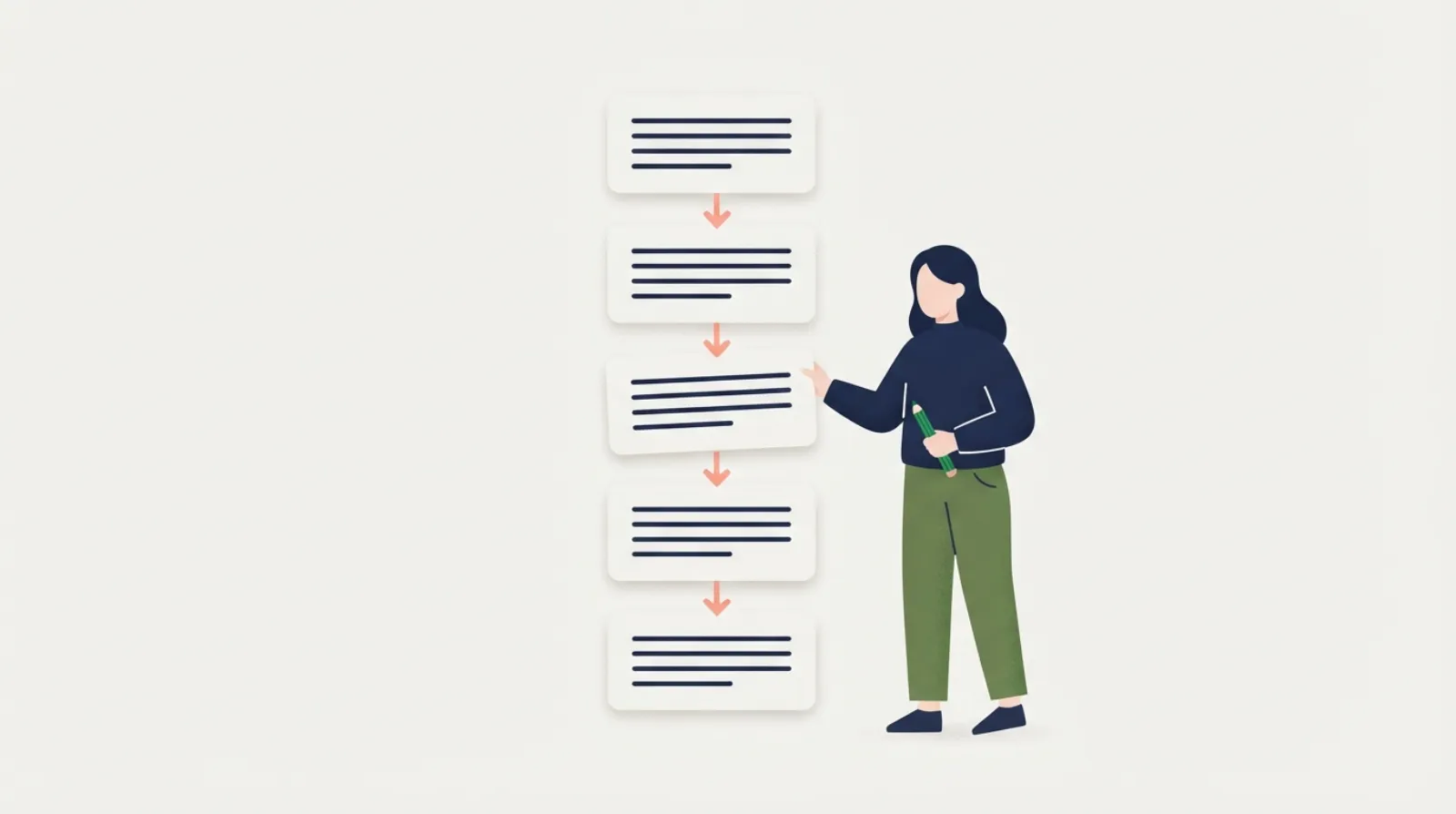
In PTE Reorder Paragraphs you see a few short paragraphs, usually four or five, in a jumbled order and drag them into the order that makes a logical text. It appears 2–3 times in the Reading part. Scoring is by correct adjacent pairs: each pair of paragraphs that stands next to each other in the right order earns a point, so you can score well even if the first paragraph is wrong.
What you see
| Part of the test | Reading |
| Tasks per test | 2–3 (the number varies) |
| On screen | usually 4–5 paragraphs in a box on the left, an empty box on the right |
| What you do | drag the paragraphs across into the right order |
| Scoring | one point per correct adjacent pair, no negative marking |
Reading is timed as a part, not task by task. In Nomto’s trainer a Reorder Paragraphs task gets two and a half minutes, which is a good pace to aim for. See the PTE exam pattern for the full Reading section.
How it is scored: adjacent pairs
The task does not check whether each paragraph sits in its “own” position. It checks the links. With five paragraphs there are four links (1→2, 2→3, 3→4, 4→5), so the maximum is 4 points. With four paragraphs it is 3.
Here is a practice task from Nomto with five paragraphs, already in the correct order:
A. A 3D printer builds solid objects from a digital design, adding material layer by layer instead of cutting it away from a larger block.
B. The process begins on a computer. A designer creates a three-dimensional model of the object, using software that records its exact shape and size.
C. Next, a second program slices this model into hundreds of thin horizontal layers and turns each layer into instructions that the printer can follow.
D. The printer then heats a thin thread of plastic until it melts and pushes it through a small nozzle, drawing the first layer onto a flat plate.
E. When one layer has cooled and hardened, the plate moves down slightly and the next layer is drawn on top of it. This continues until the object is complete.
The correct pairs are A–B, B–C, C–D and D–E. Now four different answers:
| Your order | Pairs that are correct | Score |
|---|---|---|
| A B C D E | A–B, B–C, C–D, D–E | 4 / 4 |
| B C D E A | B–C, C–D, D–E | 3 / 4 |
| A B D C E | A–B | 1 / 4 |
| A C B E D | none | 0 / 4 |
The second row is the key lesson. Not a single paragraph is in its correct position, yet the answer scores 3 out of 4, because three links are right. The third row shows the opposite: swapping two paragraphs in the middle breaks three links at once.
So the task rewards finding pairs that clearly belong together. If you are sure that C follows B, keep them together whatever happens to the rest.
How to find the first paragraph
The opening paragraph usually:
- introduces the topic in general terms (A 3D printer builds solid objects…);
- uses a full noun, not a pronoun (honeybees, not they);
- does not start with a linking word such as However, Next, This, As a result.
Paragraphs that start with They, This process, The study, However or Because of this point back to something, so they cannot come first. In the 3D-printer task, B starts with “The process begins”, which refers to a process already named, and C starts with “Next”. Only A can open.
How to find the links
Each paragraph after the first has a “hook” that refers back. In another practice task from Nomto, about honeybees, the links are clear once you look for them:
- “They do this with a movement known as the waggle dance” — they are the honeybees from the opening, and this is their sharing of information.
- “The direction of the straight line…” — the line is the one walked in the dance just described.
- “Because the information is so exact, a colony can send many workers…” — this sums up the previous paragraph and gives a consequence, so it comes last.
Hooks to look for:
| Hook | What it tells you |
|---|---|
| Pronouns: it, they, this, these, such | the noun they refer to is in the paragraph before |
| The + a noun mentioned before | the earlier mention comes first |
| Sequence words: first, next, then, finally | the order of steps |
| Contrast and result: however, as a result, therefore | a paragraph making the opposite point, or the cause, comes before |
| A name in full, then a surname or role | the full name comes first |
| A date or time order | earlier events usually come first |
Tips
- Find the opener first. It is the paragraph that makes sense with no text before it.
- Then build pairs, not a full order. Look for two paragraphs that must be together because of a pronoun or a the + noun link. Lock them.
- Read only the first and last lines closely. The links live at the start of a paragraph (the hook) and at its end (what the next one picks up).
- Check the ending. The last paragraph often gives a result, a recommendation or a future step.
- Read the finished order once from top to bottom. If any paragraph’s first word points to something you have not read yet, move it.
- Do not spend too long. If two orders both look possible, pick the one with the more certain pairs and move on; the clock is shared with the rest of Reading.
Common mistakes
- Choosing the opener because it is the longest or has the most information.
- Following the topic loosely instead of the actual words that link paragraphs.
- Changing a confident pair in order to fix a doubtful one. Remember the scoring: a confident pair is a sure point.
- Forgetting the last paragraph in the left box. A paragraph left out breaks the pairs around it.
Templates and tricks
There is no template for this task. “Always put the paragraph with a date first” or “the shortest one goes last” are not rules, and they fail on many texts. The only method that carries over is reading for hooks: pronouns, the + noun, sequence and logic words.
Common questions
How is Reorder Paragraphs scored in PTE? By correct adjacent pairs. With five paragraphs there are four possible points. Each pair that is next to each other in the right order earns one.
Is there negative marking in Reorder Paragraphs? No. A wrong pair simply earns nothing.
What if I get the first paragraph wrong? You lose the pairs around it, but the other correct pairs still count. An order with every paragraph shifted by one place can still score 3 out of 4.
How many Reorder Paragraphs tasks are there? The current format describes 2–3 in the Reading part; the exact number varies by test.
Practise with instant pair-by-pair marking
Nomto’s trainer has a bank of Reorder Paragraphs tasks in exam timing, marked pair by pair as on the test. The review shows which links you got right and explains each one, so you learn to spot hooks, not to memorise texts. For the other Reading tasks see Fill in the Blanks and the multiple-choice guide; to see your Reading score next to the other skills, try a mock test.
PTE Academic™ is a trademark of Pearson. Nomto is independent and not affiliated with or endorsed by Pearson.