TOEFL · Guides · October 30, 2026 · 9 min read
TOEFL Home Edition 2026: requirements, room rules, price and who accepts it
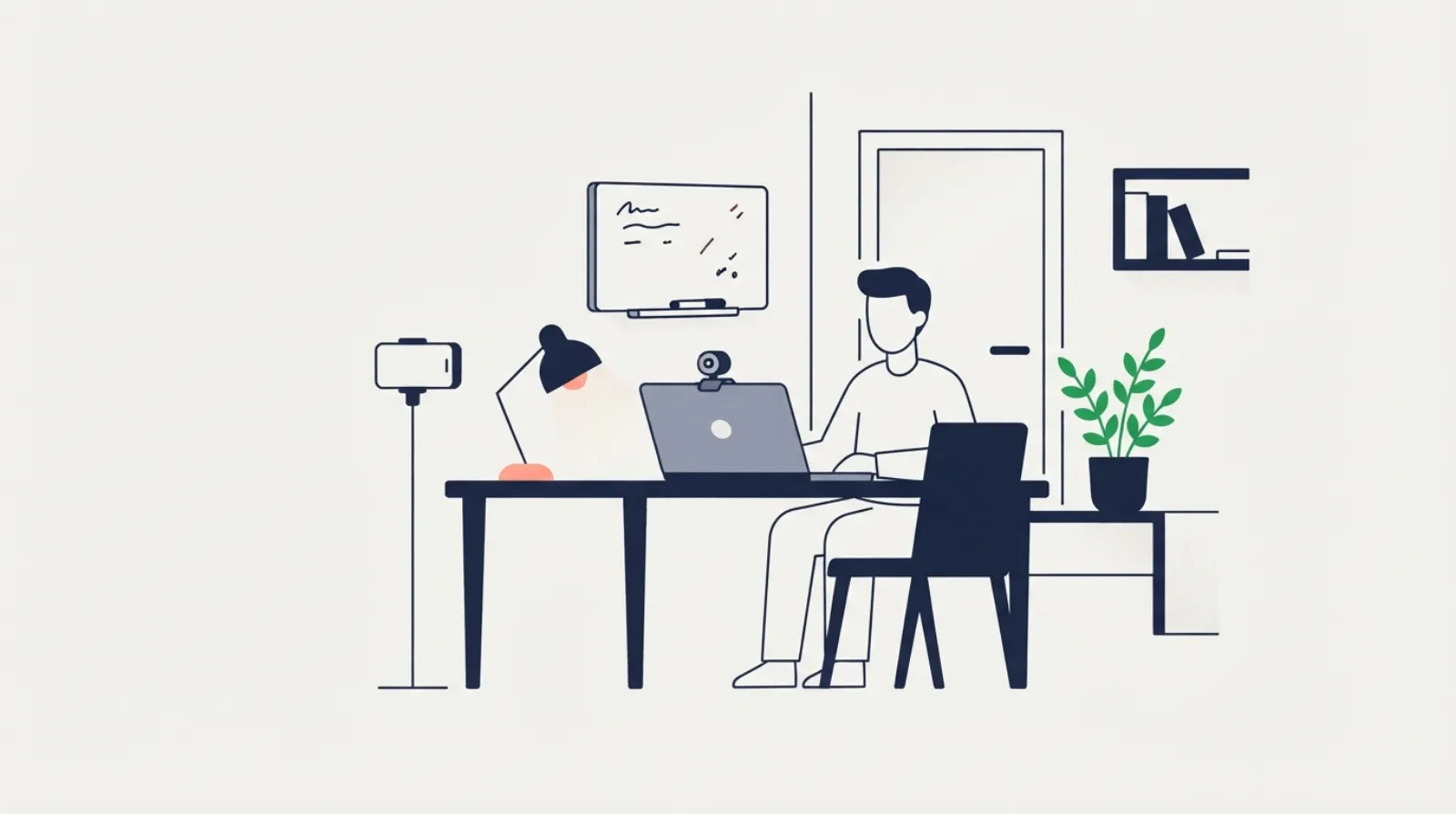
The TOEFL iBT Home Edition is the same TOEFL iBT test taken on your own computer at home, watched live by a human proctor through your webcam. The content, timing, scoring and score report are the same as at a test centre, and ETS lists one fee per country, with no separate Home Edition price (₹15,729 in India, $280 in the US). You need a Windows or Mac desktop or laptop (no tablets or phones), a webcam you can move around the room, built-in or external speakers (headphones and earbuds are not allowed), a microphone that is not part of a headset, and a private room with a clear desk. Most universities accept it in the same way as a centre test; the main exception is Australian visas, which do not accept Home Edition scores.
All rules below come from ETS’s Home Edition pages, the equipment check page and the 2026–27 TOEFL iBT Information Bulletin, checked on 30 October 2026. ETS updates them often, so read the current requirements page again before your test day.
TOEFL Home Edition at a glance
| Home Edition | |
|---|---|
| Test | the same TOEFL iBT: Reading, Listening, Writing, Speaking, about 2 hours with directions |
| Supervision | a human proctor watching live; the whole session is recorded |
| Booking | at least 24 hours ahead; appointments 24 hours a day, 4 days a week |
| Price | one TOEFL iBT fee per country on ETS’s list; no separate price |
| Device | Windows or Mac desktop or laptop only |
| Breaks | none, unless approved as an accommodation |
| Scores | in your ETS account about 3 days after the test |
| Valid for | 2 years |
Computer and equipment requirements
ETS’s at-home requirements page lists the following:
- Computer: a desktop or laptop. Tablets, phones and hybrid devices such as the Microsoft Surface are not allowed. One monitor and one keyboard only.
- Operating system: a licensed copy of Windows 11 or higher, or macOS 10.13 or higher.
- Software: you install the TOEFL Test App from your My TOEFL Home dashboard and run its Equipment Check, which tests the webcam, microphone, system, network and software. ETS advises running it between a week and 48 hours before the test, ideally on the same weekday and time of day as your appointment.
- Speakers: internal or external. Headsets, headphones and earbuds are not allowed.
- Microphone: internal or external, but not part of a headset.
- Webcam: built-in or separate, and you must be able to move it to show the proctor the whole room, the desk and the area under it.
- Second camera, if your session uses one: a phone or tablet (iOS 12+ or Android 8+), charged and plugged in, placed about an arm’s length away so it shows your screen, keyboard, hands and side.
- Power: keep the computer plugged in for the whole test.
Remote-access, screen-sharing or virtual-machine software found during the test ends the test, with no refund. And if your equipment does not meet the requirements on test day, ETS says you cannot test and get no refund or free reschedule. That is the most expensive mistake people make with the Home Edition, so run the check early.
The room and the desk
- You must be alone, and nobody may come in during the test. Public places such as a café, library or park are not allowed.
- Doors closed, glass doors and large open windows covered, nothing about the test on the walls. The door should be visible to the proctor.
- A desk or table and a standard chair; not a bed, sofa or armchair.
- A clear desk. No food or drink. Your phone goes behind you, out of reach, unless it is the second camera.
- Ears and face visible. No face masks. Remove jewellery, smartwatches and hair accessories (wedding and engagement rings can stay). Religious headwear is fine if your ears can be seen. Glasses are inspected.
- Notes: not on paper. You may use one small whiteboard with an erasable marker, or one sheet of paper inside a transparent sheet protector with an erasable marker. At the end you show the proctor that everything is erased, front and back.
- A mirror or a phone for check-in, so the proctor can see your screen.
ID and check-in
You need a valid government-issued ID, such as a passport, national ID card or driving licence, with your name and date of birth exactly as in your ETS registration.
Before test day, if ETS asks you to, verify your ID in the Entrust identity app at least 48 hours before the test: scan a QR code, photograph your ID, scan its chip and take a selfie. If the app cannot read IDs from your country, the proctor checks your ID on test day instead.
On test day:
- Start check-in up to 15 minutes before your appointment, from the confirmation email or your My TOEFL Home dashboard. If you have not started within 30 minutes after the start time, the test is cancelled and the fee is not refunded.
- The TOEFL Test App opens a virtual waiting room.
- Connect the second camera if your session uses one.
- The proctor checks your ID and takes your photo, which is shared with institutions that receive your scores.
- You show the room with the webcam: all walls and corners, under the desk, the whole work area.
- A final equipment check with the proctor, then the test begins.
Proctoring and the rules during the test
A human proctor monitors you live by webcam and can contact you by chat. The whole session is recorded. ETS lists behaviours that can invalidate the test, including talking aloud, looking away from the screen, leaving the camera view and taking a break. There are no breaks, so use the bathroom and drink water before check-in. If you break the rules, ETS can cancel your scores without a refund.
Reading items aloud is a common habit; at home it counts as talking. Practise reading silently.
Who accepts the TOEFL Home Edition
ETS says the Home Edition is the same test, its scores are used in the same way, and nearly all universities accept the scores equally. Universities’ own pages back this up for many schools: Imperial, LSE, Edinburgh, Toronto, UBC, Illinois and Harvard’s Graduate School of Arts and Sciences all accept it explicitly (October 2026; details and links in what is a good TOEFL score).
Where it is not accepted or has limits:
- Australia (visas): ETS and the Department of Home Affairs say Home Edition scores are not accepted for Australian visas. For a visa you must take TOEFL iBT at a test centre and select “Taking TOEFL for Australia” when registering. Australian universities themselves may accept the Home Edition for admission; check the course page.
- Canada’s former Student Direct Stream: ETS listed the Home Edition as not accepted, but the stream itself ended in November 2024. Canadian universities set their own rules, and Toronto and UBC accept the Home Edition.
- United Kingdom: TOEFL in any form is not a UK visa test (SELT). Universities that assess English themselves for degree courses may accept the Home Edition.
- Mainland China: the Home Edition is booked through the national TOEFL site in China, not the global ETS site.
- Iran: ETS has paused TOEFL testing in Iran.
Always check the programme page. If it says “TOEFL iBT” with no mention of the Home Edition, ask the admissions office before you book.
Pros and cons
| Pros | Cons |
|---|---|
| Book with 24 hours’ notice; appointments around the clock 4 days a week | Strict equipment rules; failing them on the day means no refund |
| No travel; useful if the nearest centre is far | No headphones: the audio plays through speakers |
| Your own keyboard and familiar setting | You must find a quiet room where nobody will come in |
| The same price, test and score report as a centre | Not accepted for Australian visas; some institutions may ask questions |
| Same scores and validity (two years) | Any noise or interruption can end the test |
The speaker rule matters more than it seems. Listening tasks and Listen and Repeat play the audio once, so a noisy room costs points. Test your speakers at the volume you will use and close windows.
How to prepare for testing at home
- Run the ETS Equipment Check a week and again two days before the test, on the same computer, network and room.
- Practise with the same setup: speakers, not headphones, and a whiteboard or a sheet in a sheet protector for notes.
- Take at least one full mock test in that room, in one sitting with no pauses. Nomto’s adaptive mock tests run with the test timing and audio played once, and end with a 1–6 band per section and the 0–120 total; speaking and writing are scored by AI on the official rubrics, marked as an estimate.
- Practise speaking into the computer microphone: Listen and Repeat and Take an Interview are both recorded on the test.
For the full test structure, see New TOEFL format 2026; for booking steps, TOEFL registration and test dates; for prices, TOEFL exam fee 2026.
Common questions
Is the TOEFL Home Edition cheaper? No separate price is listed: ETS’s fee list has one TOEFL iBT fee per country, and the price shown at booking is what you pay.
Can I use headphones? No. Headsets, headphones and earbuds are not allowed; use your computer’s speakers or external speakers.
Can I take the Home Edition on a Chromebook or iPad? No. ETS requires a Windows or Mac desktop or laptop and does not allow tablets or phones.
How long do results take? The same as a centre test: in your ETS account about three days after the test, with the PDF score report 24–48 hours after that.
Is the Home Edition accepted in the UK? By many universities for degree admission, yes. It is not a UK visa test, but neither is a centre TOEFL.
Is it accepted for Australian PR or visas? No.
Sources (checked 30.10.2026)
- ETS, At-home testing: human proctor, no headphones, room scan, second camera, availability.
- ETS, At-home requirements: computer, OS, speakers, microphone, webcam, room and desk rules, photo shared with institutions.
- ETS, At-home test day: check-in steps, ID, behaviours that invalidate a test, note-taking.
- ETS, Equipment check: what the check tests, when to run it, prohibited software.
- ETS, Testing policies FAQ: no hybrid devices, Entrust ID verification, no breaks, glasses checked.
- ETS, ID requirements: valid government-issued ID for home testing.
- ETS, 2026–27 TOEFL iBT Bulletin, pp. 6, 10–11: check-in window, recording, no scheduled breaks, Australian visa rule.
- ETS India, Home Edition acceptance: accepted “in the same way”; SDS note.
- ETS, Study in Australia and Department of Home Affairs, English language: Home Edition not accepted for visas.
- ETS, Taking the test FAQ: mainland China Home Edition through the national site; ETS get scores: Iran pause, score timing.
TOEFL® and TOEFL iBT® are registered trademarks of ETS. Nomto is not endorsed or approved by ETS.
Also in Bahasa Indonesia, Русский, Türkçe, Tiếng Việt, Español, Português (Brasil)