How to write Chinese characters: strokes and stroke order
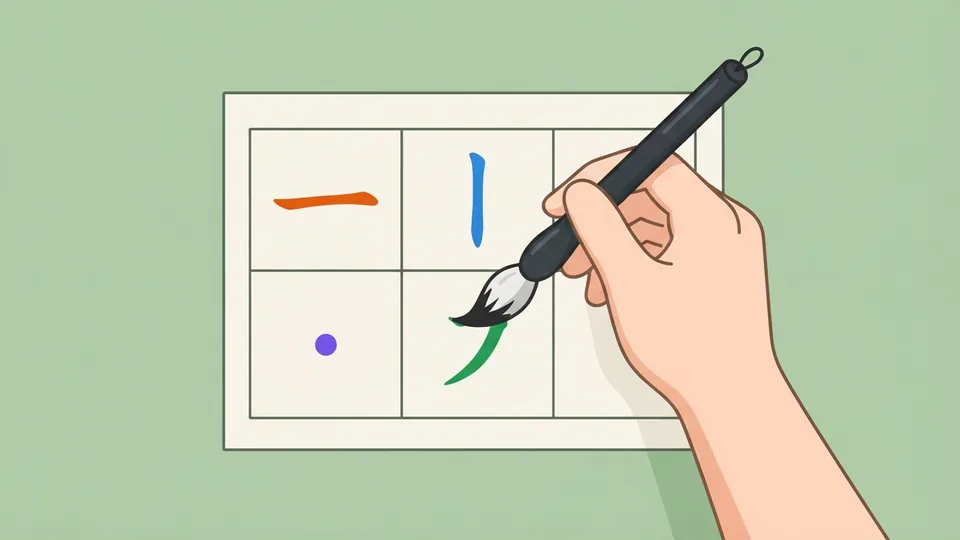
Chinese characters aren't drawn any old way: they're written stroke by stroke, in a set order. A stroke is a line made in one movement, without lifting the pen. There are eight basic strokes and seven stroke order rules, and they're the same for almost every character. Learn them once and you can correctly write a character you've never seen before.
The strokes of Chinese characters: the basic eight
Every stroke has a name and a direction: a horizontal always goes left to right, a vertical always goes top to bottom. With all their variants there are about thirty strokes, but they're all built from these eight. The table gives each stroke's name, what it looks like and an HSK 1 character where it's easy to spot. Tap the character to hear it.
| Stroke | What it looks like | Example |
|---|---|---|
| 横 héng — horizontal | A straight line from left to right, rising slightly at the end | — the whole character |
| 竖 shù — vertical | A straight line from top to bottom | — the second stroke |
| 撇 piě — left-falling | Down and to the left, tapering off at the end | — the first stroke |
| 捺 nà — right-falling | Down and to the right, getting wider at the end | — the second stroke |
| 点 diǎn — dot | A short stroke downwards, usually at a slant | — the first stroke |
| 提 tí — rising | A short line from lower left up to the right | — the fourth stroke |
| 钩 gōu — hook | A short, sharp flick at the end of another stroke | — the first stroke |
| 折 zhé — turn | The stroke changes direction without the pen leaving the paper | — the second stroke |
The hook and the turn rarely appear on their own: they're ways to end or continue another stroke. A vertical with a hook, a horizontal that turns down: each of these counts as one stroke, because it's written in one movement.
Direction is part of the stroke. The two falling strokes differ in more than their slant: the left-falling one starts with pressure and thins out towards the end, while the right-falling one starts thin and ends in a wide "tail". With a ballpoint pen you can hardly see this, but your hand should move the same way, and then the character comes out recognisable.
Chinese stroke order: seven rules
You don't need to memorise the stroke order of each character separately. Seven rules are enough: they cover a simple character of two strokes and a complex one of fifteen. A complex character is a few simple parts, and each part is written by the same rules, one part after another.
- Top to bottom. In you write the top line first, then the middle one, then the bottom one.
- Left to right. In 川 chuān — river the three strokes go in turn from left to right. The parts of a character work the same way: in you write the left side first, then the right.
- Horizontal before vertical. When strokes cross, the horizontal comes first: .
- Left-falling before right-falling. : first the stroke to the left, then the one to the right. The same goes for and .
- Outside before inside. In you write the frame first (the left stroke, then the top and right side in one movement) and only then the two strokes inside. works the same way.
- The closing stroke comes last. If a frame is closed, you don't close it until it's filled: in and in the bottom line goes at the very end. As Chinese teachers put it: first go into the house, then shut the door.
- Middle before the sides. In a symmetrical character the central stroke goes first, then the left and the right: , .
The dot is worth remembering on its own. If it sits at the top or the top left, you start with it: . If it's at the top right or inside the character, you finish with it: in the dot on the right goes last.
Why stroke order matters
A character written in any order can still be read. But the right order has four practical benefits.
- The character comes out even. The order is designed to be comfortable for the hand: each stroke starts close to where the last one ended, and the proportions take care of themselves.
- Your hand remembers. When you write a character with the same chain of movements every time, you remember it as a movement, not as a picture. That makes it easier to recall later.
- Your phone understands you. Handwriting input and "draw the character" dictionary search take the sequence and direction of strokes into account. Get the order wrong and the character you want may not come up.
- Handwriting stays readable. In fast writing strokes run together, and they join in exactly the order they were written. A character put together differently looks different in cursive, and people won't recognise it.
How to count the strokes in a character
There's one rule: each time the pen touches the paper and lifts off, that's one stroke. So 口 "mouth" has three strokes, not four: the top and the right side are a single turning stroke. Try counting these yourself and check:
- 人rénperson2 strokes
- 大dàbig3 strokes
- 小xiǎosmall3 strokes
- 中zhōngmiddle; in, among; Chinese4 strokes
- 我wǒI, me7 strokes
- 你nǐyou7 strokes
- 国guócountry8 strokes
Why bother: paper dictionaries arrange characters by radical and stroke count, and many digital ones can search by that number too. When you don't know how a character is read, it's a reliable way to find it. What a radical is and how to spot it is explained in the article on Chinese radicals.
How to write Chinese characters in a grid
Every character, simple or complex, takes up the same square. That's why people learn to write in a square with a cross inside, called 田字格 tiánzìgé after the character , which it looks like. The cross divides the square into four parts and shows you where a stroke starts, where it crosses the middle and how much bigger one part of the character is than another.
- Fit the character into the square. It shouldn't touch the edges or huddle in a corner. In a character with two parts, the parts share the box between them instead of standing side by side like two separate letters.
- What to write with. An ordinary pen or pencil is fine. Brush and ink are calligraphy, which is a separate pursuit.
- What to write on. Graph paper works: outline a square of two by two or three by three cells and draw a cross in it. Ready-made sheets with this grid can be printed from the handwriting sheets, including a blank grid.
How to learn Chinese characters: a routine that works
Writing and remembering are two different jobs. The stroke order rules tell you how to write Chinese characters; to make a character stay in your memory, you also need a system. Here's a routine that works for your first few hundred characters.
- Take the character apart first. Look for familiar parts, the radicals. A character made of two parts you know is easier to remember than one made of ten separate lines.
- Check the order and write it 5–10 times. The first few times looking at the model, the last few from memory. Say the character out loud as you write: that ties the reading to the writing.
- Come back the next day. One line tomorrow and another a week later do more than a full page in one evening. That's spaced repetition.
- Learn the character with a word. Not 国 on its own, but . The words of the first level are in the HSK 1 word list.
Common beginner mistakes
- Drawing instead of writing. Copying a character like a picture: tracing the outline, adding details, moving the pen back and forth. The result looks similar, but you remember neither the order nor the direction.
- Writing a stroke bottom to top or right to left. A vertical always goes down, a horizontal always goes right. The only stroke written entirely upwards is the rising stroke.
- Skipping the hook. Without the hook it's a different stroke, and sometimes a different character. The hook is short but clear.
- Splitting one stroke into two. The top and the right side of a frame are one movement. If you lift the pen at the corner, both the stroke count and the order go wrong.
All four have the same cure: for the first few weeks, write slowly and check the stroke order chart, even if the character looks simple. Speed comes by itself, and retraining your hand later takes much longer.
If you're just starting out and haven't decided what to tackle first, see how to start learning Chinese.
Handwriting sheets that check your strokes
Write with your finger or mouse: every stroke is checked right away, and after two misses you get a hint.
Open the handwriting sheets