IELTS · Guides · October 24, 2026 · 4 min read
IELTS Writing Task 1 process diagram: how to write it, with a model answer
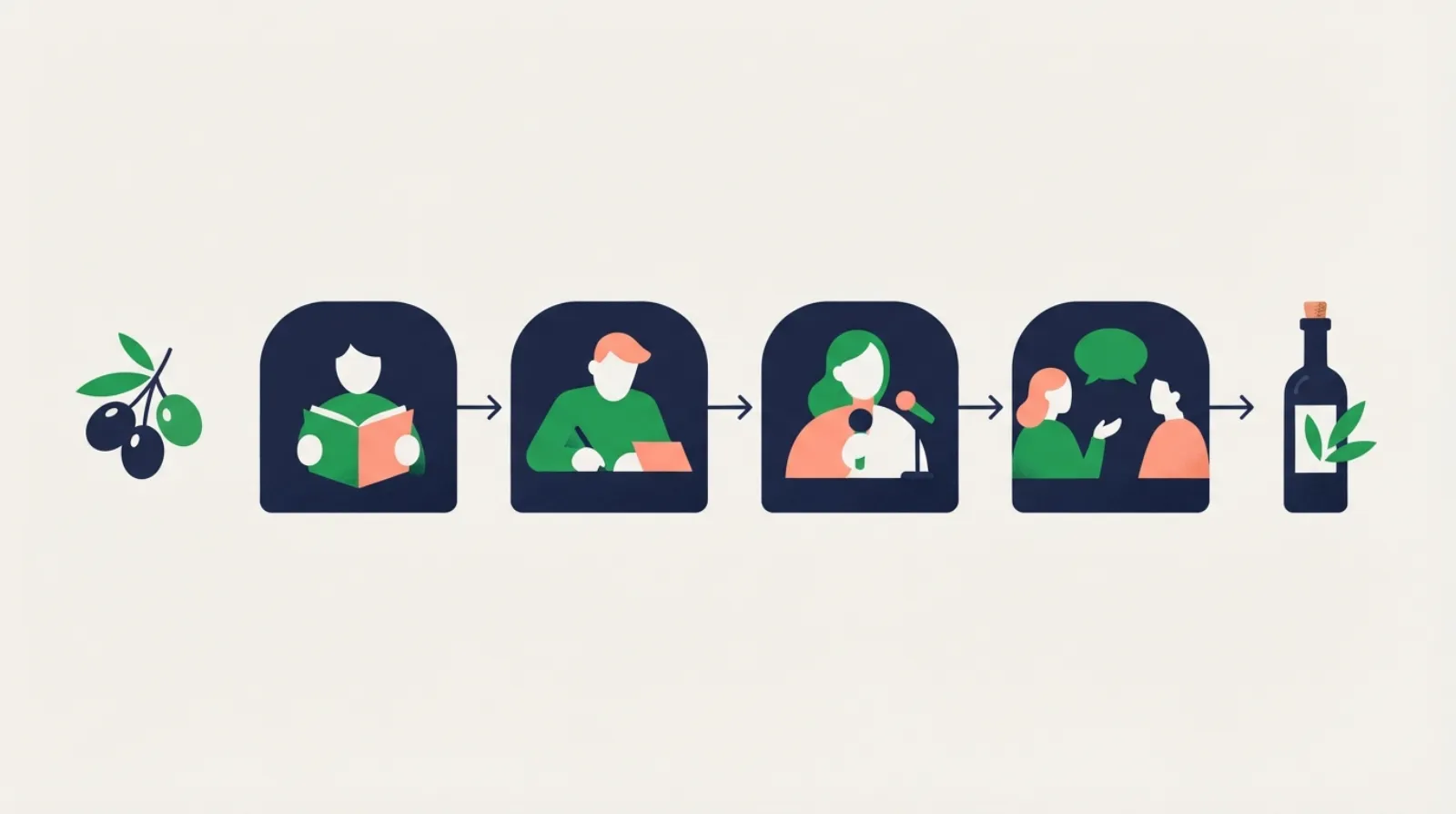
A process diagram shows how something is made or how something works: how bricks are produced, how rainwater is collected, how a coffee bean becomes instant coffee. There are no numbers to compare. Instead, the examiner checks whether you can describe a sequence clearly, with the right grammar, and still give an overview. It appears less often than charts, but it is the Task 1 type candidates fear most, because they have not practised it.
Two kinds of process
- Manufacturing (man-made): raw materials go in, a product comes out. Clay is dug up, shaped, fired and packed. Use the passive voice, because the people doing the work are not important.
- Natural: a cycle in nature, like the life cycle of a frog or the water cycle. Use the active voice in the present simple: the eggs hatch, water evaporates.
Before you write
- Find the start and the end. Follow the arrows. In a cycle, choose a sensible starting point.
- Count the stages. The overview will say how many there are.
- Note the vocabulary on the diagram. You may use the labels, but turn them into sentences; crushing becomes the beans are crushed.
- Split the process in two for the detail paragraphs: for example, preparing the material and making the product.
Sequencing language
First / To begin with, next, then, after that, once (once the bricks have cooled), at the next stage, subsequently, meanwhile, before being (before being packed), finally, at the end of the process.
Vary the sentence shapes: After being dried, the leaves are rolled and The leaves are dried and then rolled say the same thing in two different ways.
A model answer
Task: The diagram below shows how olive oil is produced. Summarise the information by selecting and reporting the main features.
The diagram shows eight stages: harvesting the olives, transporting them to a mill, washing them to remove leaves and dirt, crushing them with their stones into a paste, slow mixing so that drops of oil join together, separating the oil from water and solids in a centrifuge, filtering, and bottling.
The diagram illustrates the stages involved in producing olive oil, from picking the fruit to bottling the finished product.
Overall, the process consists of eight main steps and can be divided into two phases: the olives are first collected and prepared, and the oil is then extracted, cleaned and packaged. The process begins in the olive grove and ends with bottled oil that is ready for sale.
To begin with, ripe olives are harvested from the trees and transported to a mill. There, they are washed to remove leaves and dirt before being crushed, together with their stones, into a thick paste. This paste forms the basis of the second phase.
At the next stage, the paste is mixed slowly, which allows small drops of oil to join together. It is then placed in a centrifuge, where the oil is separated from the water and the solid parts of the fruit. Finally, the oil is filtered to remove any remaining particles and poured into bottles, ready to be sold.
169 words. The passive voice carries the whole answer, and every stage on the diagram is mentioned once.
Common mistakes
- No overview. “There are eight stages, from harvesting to bottling” is enough, but it must be there.
- Copying the labels as a list: Washing. Crushing. Mixing. Each stage needs a full sentence.
- Wrong passive forms: the olives are wash, the oil is separate. Check every past participle.
- Adding information that the diagram does not show, such as the temperature, the price or the country.
- Skipping a stage. Tick each stage on the question paper as you describe it.
Practise
Write the model task above in 20 minutes and compare, then try a process diagram in the practice room. The AI examiner gives a band for each criterion and checks that the overview names the number of stages and that no stage is missed:
- How bricks are made: eight stages, from digging clay to delivery
- From cocoa beans to chocolate: a longer manufacturing process, nine stages
- Recycling glass bottles: a man-made cycle
- The life cycle of a butterfly: a natural cycle
- Writing Task 1 guide: the four-paragraph structure
- Maps in Task 1, the other non-chart task
Common questions
Should I use the passive in every sentence? In a man-made process, mostly yes. One or two active sentences (the machine separates the oil) add variety.
Can I use words from the diagram? Yes, but change their form: labels are often nouns (filtration), and you need verbs (is filtered).
Is a process diagram harder than a chart? It usually needs fewer words, because there are no numbers. Most candidates reach 150 words easily if every stage gets a sentence.
Also in Tiếng Việt