TOEFL · Guides · October 25, 2026 · 7 min read
TOEFL ITP vs iBT vs TOEFL Essentials (2026): differences, scores and who accepts which
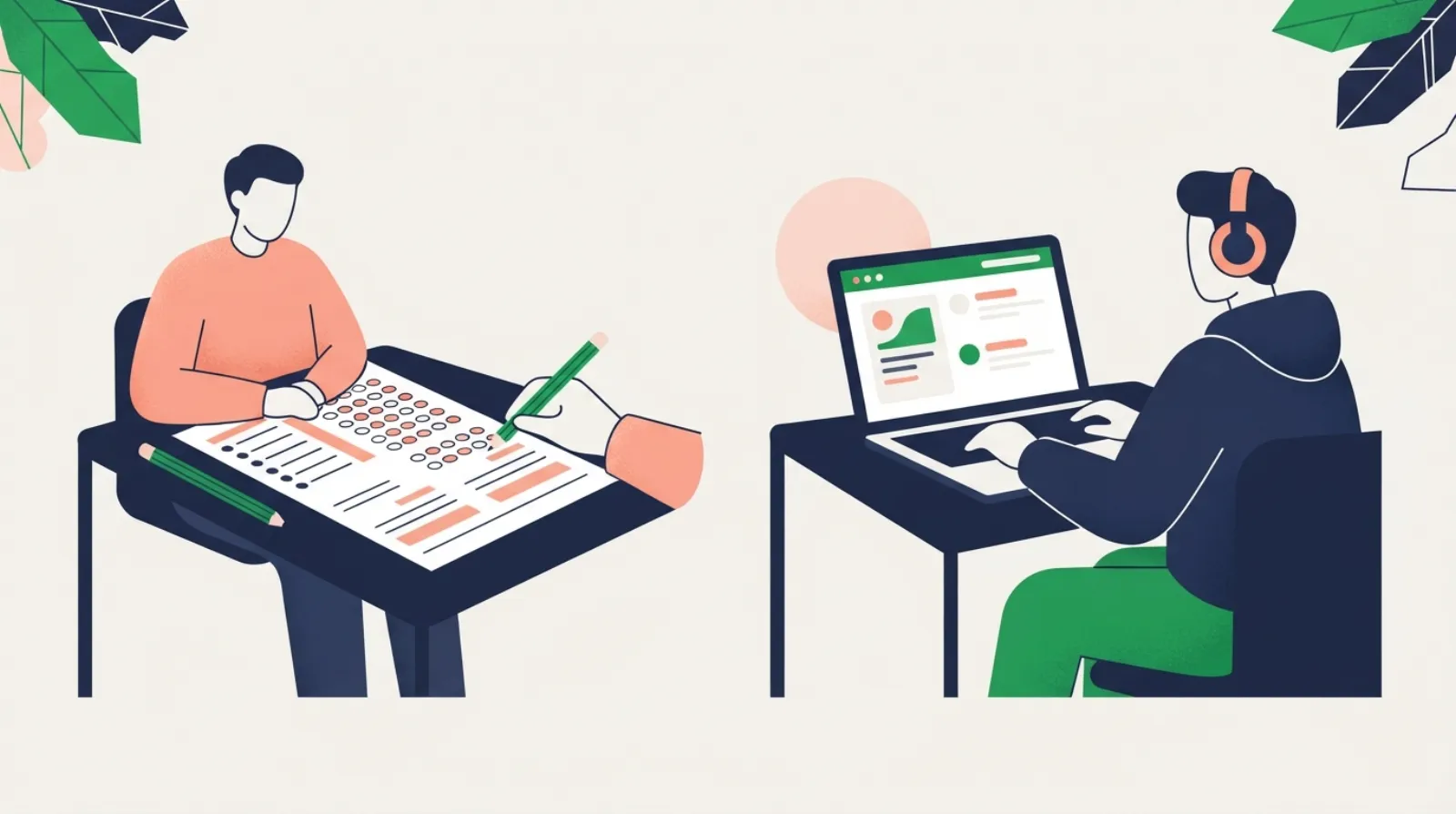
TOEFL iBT is the test you book yourself for university admission abroad: four skills, about 1.5 hours, scored 1–6, accepted by more than 13,500 institutions in over 160 countries according to ETS. TOEFL ITP is an institutional test that schools and universities buy and run for their own students, mostly multiple choice, on paper or computer, scored 310–677 (Level 1); ETS says it should not replace the iBT. TOEFL Essentials is a separate at-home test of about 1.5 hours, scored 1–12, that ETS still offers in 2026 but that fewer universities accept. If an application simply says “TOEFL”, it almost always means the iBT.
Details below are from ETS’s TOEFL iBT, TOEFL ITP and TOEFL Essentials pages and their 2026–27 bulletins, as of October 2026.
Side by side
| TOEFL iBT | TOEFL ITP | TOEFL Essentials | |
|---|---|---|---|
| Who it is for | individuals applying to study, work or migrate | institutions testing their own students | individuals, as an alternative to the iBT where accepted |
| Who books it | you, through ETS | the school or university that runs it | you, through ETS |
| Where | test centre or at home (Home Edition) | at the institution, paper or digital | at home |
| Skills | Reading, Listening, Writing, Speaking | Listening, Structure and Written Expression, Reading; optional Speaking | Listening, Reading, Writing, Speaking + unscored video statement |
| Length | about 1.5 hours | Level 1: 115 min; Level 2: 70 min | about 1.5 hours |
| Scale | 1–6 in half bands (+ comparable 0–120 during a two-year transition) | Level 1: 310–677; Level 2: 200–500 | 1–12 |
| Scores in | about 3 days | from the institution or local ETS office | 5–6 days |
| Validity | 2 years | 2 years | 2 years |
| Price | set by country (₹15,729 in India, $280 in the US) | set by the institution | $199; ₹17,200 in India |
TOEFL iBT: the admissions test
The iBT is what universities mean by “TOEFL”. Since 21 January 2026 it has a new format: Reading and Listening are two-stage adaptive, Writing has Build a Sentence, an email and an Academic Discussion post, and Speaking has Listen and Repeat and a short interview. Sections and overall scores run from 1 to 6, aligned with CEFR (6 = C2, 5–5.5 = C1, 4–4.5 = B2). Details: the new TOEFL format and TOEFL score chart 2026.
You choose the date and place, scores go straight to universities from your ETS account, and the same result works for applications in many countries. One caveat from ETS’s own bulletin: for Australian visas, only iBT tests taken before 21 January 2026 and the separate TOEFL iBT Australia are currently approved.
TOEFL ITP: the institutional test
ITP stands for Institutional Testing Program. ETS describes it as an assessment series for ages 16+ that more than 2,500 institutions in over 50 countries administer every year. Students do not register for it on ets.org; they take it where their school, university or a local ETS partner organises a session.
ITP format and scores
| ITP Level 1 (intermediate to advanced) | Questions | Time | Scale |
|---|---|---|---|
| Listening Comprehension | 50 | 35 min | 31–68 |
| Structure and Written Expression | 40 | 25 min | 31–68 |
| Reading Comprehension | 50 | 55 min | 31–67 |
| Total | 140 | 115 min | 310–677 |
Level 2 (high beginner to intermediate) is shorter: 95 questions in 70 minutes, scored 200–500. Both levels are multiple choice and come in paper or digital form. There is no writing task: “Structure and Written Expression” means choosing the correct form or spotting the error in a sentence, not writing your own text. An optional ITP Speaking test (about 15 minutes, four tasks, scored 31–68 by AI) is available only with the digital version.
ETS maps ITP Level 1 totals to CEFR as follows: C1 from 620, B2 from 543, B1 from 433, A2 from 343. Level 2 tops out at B1 (433).
What ITP is used for
ETS lists these uses: placement and progress checks in English programmes, exit tests, preparation for the iBT, admission to short non-degree and joint programmes, admission through tests run by an institution for its own use, and scholarship programmes, as supporting evidence of English. ETS adds that institutions should use ITP for these purposes and not as a replacement for the TOEFL iBT.
In practice that means:
- Your own university asks for ITP to place you in an English level, to let you graduate or to select students for an exchange: ITP is right.
- A scholarship asks for ITP: fine, if the call names it.
- A foreign university’s admissions page asks for “TOEFL”: take the iBT. An ITP score taken at another institution is generally not a substitute, and score reports go through the institution or the local ETS office, not to a list of universities you choose.
If your school has simply announced an ITP session for its own purposes, take that test for that purpose. If you plan to apply abroad later, the iBT is what you will need.
TOEFL Essentials: still offered in 2026
TOEFL Essentials is not discontinued: ETS publishes a 2026–27 Essentials bulletin and an active registration page. ETS describes it this way:
- Four sections (Listening, Reading, Writing, Speaking) plus a 5-minute unscored Personal Video Statement; about 1.5 hours, plan for 1 hour 50 minutes with check-in.
- Taken from home; adaptive, with short tasks on academic and everyday topics.
- Section scores on a 1–12 scale in full bands, overall in half bands.
- Official scores 5–6 days after the test; score reports to as many institutions as you like at no extra charge.
- Fee: US$199 in all countries and ₹17,200 in India.
The key question is acceptance. ETS itself says an “increasing number” of institutions accept Essentials and tells test takers to check with each one. Far more institutions list the iBT. Before booking Essentials, find it named on the admissions page of every programme you apply to. Note also that in India it currently costs more than the iBT (₹17,200 vs ₹15,729).
Which one should you take?
| Your goal | Test |
|---|---|
| Admission to a university abroad, bachelor’s or master’s | TOEFL iBT |
| A placement, exit or exchange test at your own university | TOEFL ITP, if that is what the university runs |
| A scholarship that names ITP in its call | TOEFL ITP |
| A programme that explicitly lists TOEFL Essentials | Essentials or iBT; the iBT keeps more options open |
| A visa or professional registration | whatever the authority lists; check it, do not assume |
| Not sure yet | TOEFL iBT |
If you are also weighing IELTS, compare formats in IELTS vs TOEFL. Prices for the iBT by country are in TOEFL exam fee 2026.
Moving from ITP to iBT
An ITP background helps with listening and reading, but the 2026 iBT is a different test. Three things will be new:
- Speaking into a microphone. Repeating sentences exactly and answering four interview questions in 45 seconds each. Start with Listen and Repeat.
- Writing your own text. An email in about 7 minutes and an academic forum post in 10. See Write an Email and Academic Discussion.
- New item types such as Complete the Words and Build a Sentence, which reward fast, accurate grammar and spelling, the closest link to ITP’s Structure section.
Nomto’s TOEFL room covers the iBT only: every task type with the test timing, audio played once, speaking and writing scored 0–5 on the official rubrics by AI (marked as an estimate), and Reading, Listening and Build a Sentence checked instantly with explanations in English, Spanish, Portuguese, Russian, Vietnamese, Turkish or Indonesian. Adaptive mock tests, full or one section, end with a report on the 1–6 scale and the 0–120 total. A free account gives you 10 Reading, Listening and Build a Sentence items, 3 spoken and 1 written answer scored by AI and a one-section mock; a pass ($15 a week, $49 for 3 months, $79 for 6 months, $119 a year) opens all courses. Start at TOEFL preparation.
Common questions
Is TOEFL ITP valid for studying abroad? It is meant for use inside the institution that runs it and for specific programmes that name it. For regular admission abroad, universities ask for the iBT.
How do I convert an ITP score to iBT? ETS’s ITP pages give no ITP-to-iBT conversion table. Both map to CEFR, so a Level 1 score of 543 or more and an iBT 4 are both B2, but a university will not accept one in place of the other on that basis.
Is TOEFL Essentials easier than the iBT? It is a different format on a different scale, not an easier version. The real difference is acceptance.
How long are ITP scores valid? Two years, according to ETS, the same as the iBT and Essentials.
TOEFL® and TOEFL iBT® are registered trademarks of ETS. Nomto is not endorsed or approved by ETS.
Also in Bahasa Indonesia, Русский, Türkçe, Tiếng Việt, Português (Brasil), Español