TOEFL · Guides · October 25, 2026 · 9 min read
TOEFL Build a Sentence: practice, tips and time limit (2026)
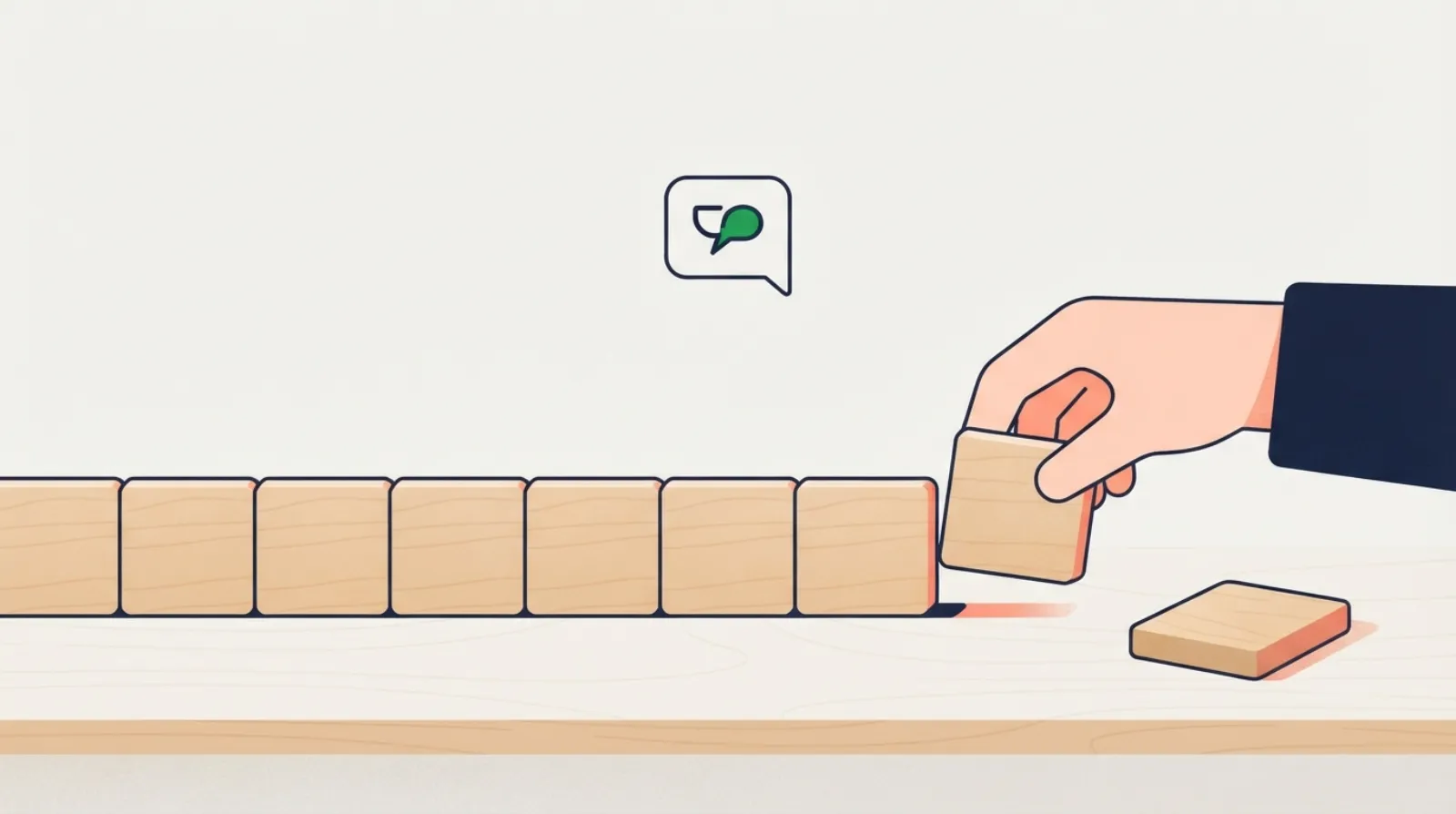
Build a Sentence is the first task of the TOEFL iBT Writing section since the 2026 update. You see a short line from one speaker and build the other speaker’s reply by putting scrambled words and phrases (tiles) into the right order. There are 10 items, each worth 1 point, and only a fully correct sentence earns the point: one tile in the wrong place scores 0. The task tests word order more than vocabulary, especially indirect questions, auxiliaries, prepositions, relative clauses and passives. With about 23 minutes for the whole Writing section and 17 of them taken by the email and the discussion post, plan on roughly six minutes for all ten sentences, a little over half a minute each.
How the task works
| Build a Sentence | |
|---|---|
| Number of items | 10, one after another |
| What you see | one speaker’s line, then a reply made of shuffled tiles |
| Tiles | single words or short phrases; one may already be fixed in place |
| Extra tile | sometimes one tile fits nowhere and must be left out |
| Scoring | 1 point if the whole sentence is right, 0 otherwise |
| Time | the Writing section is about 23 minutes in total; Email takes 7 and Academic Discussion 10, which leaves about 6 minutes for Build a Sentence |
| Section | Writing (ETS’s blueprint lists the levels as A1 to C2) |
The exchanges are short and everyday: a classmate mentions a deadline, a roommate talks about a new job, someone asks about the library. The reply is usually a question or a statement of 5 to 12 words. The first items tend to be simple; later ones bring in embedded clauses and passives.
Because scoring is all-or-nothing, a sentence that is “almost right” is worth exactly as much as an empty one. That changes how you should work: accuracy on each item matters more than speed, as long as you leave time for all ten.
What grammar Build a Sentence tests
The tiles almost always hide one of a small set of word-order problems. Learn to spot them and the task gets much faster.
- Indirect (embedded) questions. After Do you know, Could you tell me, I wonder, Have you heard the clause keeps statement order: where the office is, not where is the office. No do/does/did inside.
- Auxiliaries in direct questions. Have you been…, Did they change…, Will you work…: the auxiliary comes before the subject, the main verb after it.
- Prepositions that belong to a word. depend on, responsible for, interested in, wait for, on sale. The preposition tile must sit right after its partner.
- Relative clauses. The book that my tutor recommended was…: the clause follows the noun it describes, and it does not repeat the object (that my tutor recommended
it). - Passives. is being repaired, must be uploaded, was cancelled: the order is always be (in the right form) + past participle.
- Adverbs and time phrases. Frequency adverbs go before the main verb (I hardly ever have), time phrases usually at the end (this week, on weekends).
A 4-step method
- Read the first speaker’s line. The reply must answer or react to it. If the line is a piece of news, the reply is often a question about it.
- Find the frame. Look for the tile that can open the sentence (such as do you know, could you, the one, I wonder) and check the end mark if it is shown: a question mark means you are building a question.
- Pair the obvious partners. Join auxiliary + subject, be + participle, verb + its preposition, noun + its relative clause. Three or four pairs usually leave only one possible order.
- Read the whole sentence aloud in your head. If a tile is left over, ask whether it is the extra one. Extra tiles are usually a wrong form of something you already used: does in an indirect question, repairing next to repaired, it after a relative clause.
Ten worked examples
All examples are written for this guide. Tiles are shown shuffled, as you would see them; the extra tile, where there is one, is marked in the answer.
1. Indirect question with where Line: I’m new here, so I keep getting lost. Tiles: is / do you know / the chemistry building / where Answer: Do you know where the chemistry building is? Why: after do you know, the question becomes a statement-order clause, so the verb is goes last.
2. Indirect question with whether Line: The professor posted the reading list this morning. Tiles: the article we discussed / I wonder / includes / does / whether it Answer: I wonder whether it includes the article we discussed. (extra: does) Why: I wonder whether introduces a statement, so no does; it includes keeps the normal subject + verb order.
3. Present perfect continuous question Line: I finally sent off my scholarship application. Tiles: on it / have / been working / how long / you / did Answer: How long have you been working on it? (extra: did) Why: the auxiliary have goes before the subject you, and been working follows. Did would need a base verb, which none of the tiles provide.
4. Negative question in the past Line: The bus to the north campus was late again. Tiles: last week / the schedule / they / didn’t / change Answer: Didn’t they change the schedule last week? Why: didn’t comes first in a negative question, then the subject, then the base verb change; the time phrase goes at the end.
5. Preposition + embedded clause Line: Are you joining the study group tonight? Tiles: on / my shift / it depends / ends / when Answer: It depends on when my shift ends. Why: depend takes on, and the clause after it (when my shift ends) keeps statement order.
6. Relative clause Line: Which laptop did you end up buying? Tiles: was on sale / my roommate recommended / it / the one that Answer: The one that my roommate recommended was on sale. (extra: it) Why: the relative clause describes the one, so it follows it directly. The object of recommended is already that; adding it repeats it.
7. Present continuous passive Line: Why is the gym closed today? Tiles: repairing / is / the heating system / repaired / being / this week Answer: The heating system is being repaired this week. (extra: repairing) Why: the system does not repair anything; it receives the action, so you need is being + past participle.
8. Modal passive with a preposition Line: Can I still hand in the essay on paper? Tiles: be uploaded / to the course page / must / all essays Answer: All essays must be uploaded to the course page. Why: modal + be + participle (must be uploaded), then the destination phrase with to.
9. Frequency adverb Line: Do you cook in the dorm kitchen? Tiles: time to cook / during the week / hardly ever / I / have Answer: I hardly ever have time to cook during the week. Why: hardly ever goes between the subject and the main verb; the time phrase closes the sentence.
10. Embedded question with what time Line: A new café opened next to the library. Tiles: closes / what time / does / have you heard / on weekends / it Answer: Have you heard what time it closes on weekends? (extra: does) Why: the main question is Have you heard…?; the part after it is an embedded question, so it closes, not does it close.
Notice how often the extra tile is an auxiliary. If you see do, does or did among the tiles and the sentence starts with Do you know, I wonder or Could you tell me, the auxiliary is very likely the one to leave out.
Common traps
- Direct-question order inside an indirect question. Could you tell me where is the office? is the single most common error in this task.
- Using every tile. When there is an extra tile, a sentence that uses all of them is wrong by design. Check the leftover before you move on.
- Splitting fixed partners. Responsible for, interested in, look forward to: if the preposition ends up far from its word, the order is wrong.
- A reply that does not fit the line. Two orders can both be grammatical, but only one answers what the first speaker said. Reread the line when you are torn.
- Spending three minutes on one item. If a sentence will not come together after about a minute, choose your best order and move on; the other items are worth the same point.
- Ignoring the fixed tile. When one tile is already in place, it tells you where the sentence starts or ends. Build around it instead of moving everything in your head.
How to practise
Short, frequent sessions work best. Do a set of ten, then go through every item you got wrong and name the grammar point: indirect question, auxiliary, passive, preposition, relative clause. After a week you will see which two or three patterns cost you most, and those are the ones to drill.
Build a Sentence uses the same grammar you need in the rest of the Writing section. Indirect questions and polite requests are exactly what an email asks for (see TOEFL email writing), and relative clauses and passives help an Academic Discussion post sound precise. If you want to see where this task sits among the other eleven, read the TOEFL iBT format guide; for how ten one-point items feed into the 1–6 Writing band, see TOEFL scores.
Practise Build a Sentence in the Nomto room
The Build a Sentence practice in the Nomto TOEFL room gives you the line, the tiles (with the fixed tile and the extra tile when an item has them) and a guide time per sentence. Answers are checked instantly, and each item comes with a short explanation of the grammar point in English, Spanish, Portuguese, Russian, Vietnamese, Turkish or Indonesian. A free account includes 10 Reading, Listening and Build a Sentence items. When you are ready to see it inside the whole Writing section, take a section or full mock test, which reports your band on the 1–6 scale and the comparable 0–120 total.
Common questions
How many Build a Sentence questions are there? Ten, at the start of the Writing section.
Is there partial credit? No. Each item is worth 1 point, and you get it only if every tile is in the right place.
What is the time limit for Build a Sentence? The Writing section takes about 23 minutes. Write an Email has 7 minutes and Academic Discussion 10, so expect around 6 minutes for the ten sentences.
Is there always an extra tile? No. Some items use every tile; others include one that fits nowhere. Always check whether a leftover tile is meant to be left out.
TOEFL® and TOEFL iBT® are registered trademarks of ETS. Nomto is not endorsed or approved by ETS.
Also in Tiếng Việt, Русский, Español, Português (Brasil)