Spoken English · Articles · October 21, 2026 · 8 min read
Daily use English sentences: 150+ simple sentences for home, college, work and travel
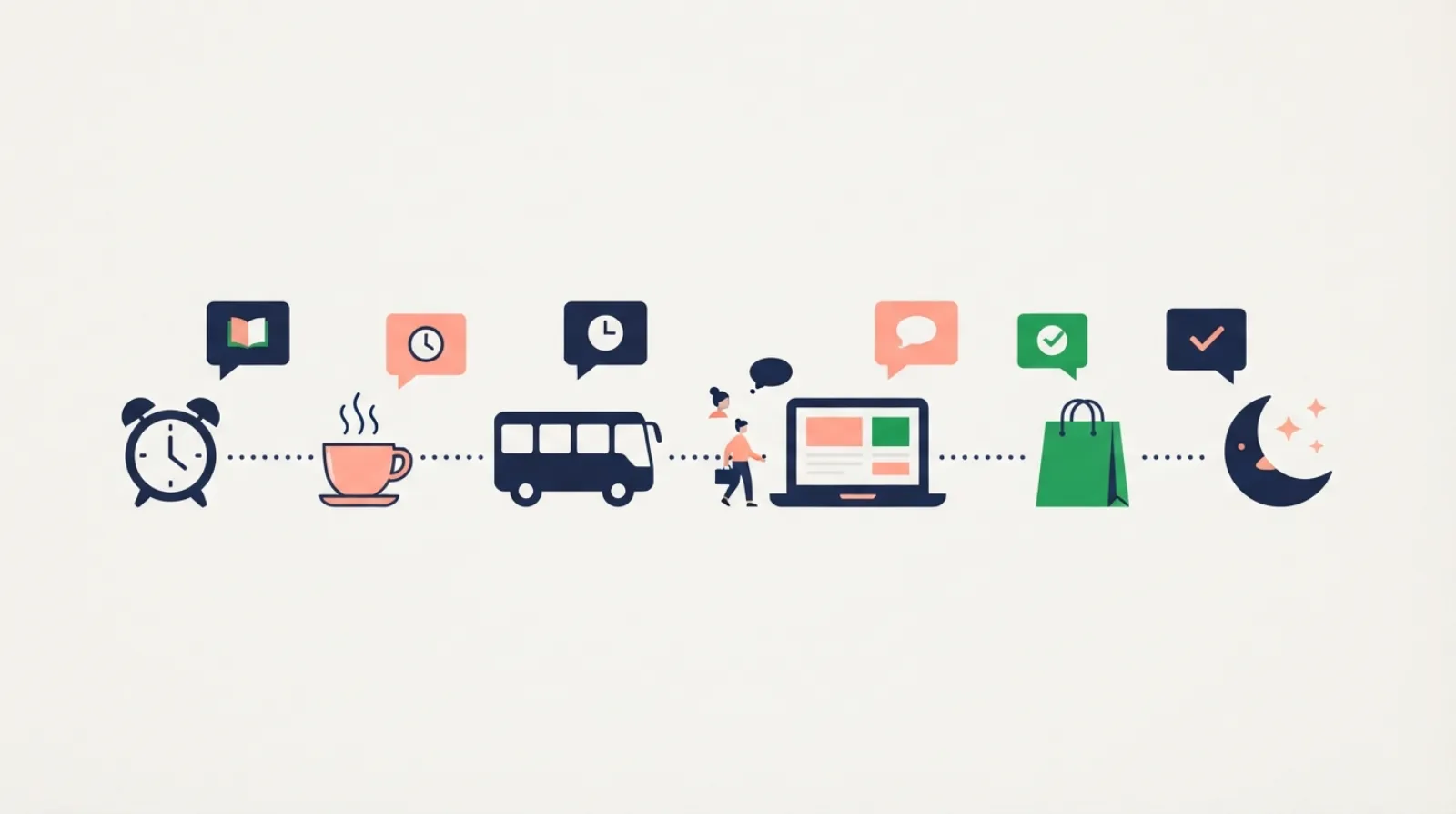
Daily use English sentences are the short, ready-made lines you say again and again: I’m running late, Can you pass me the salt?, Let me call you back. Learning them as whole sentences, not word by word, is the fastest way to speak simple English without translating in your head. Below are more than 150 sentences grouped by situation, with notes on when to use them and a short list of common mistakes.
How to use this list: pick one section a day, say every sentence out loud, then change one word in each (I’m running late → She’s running late, We’re running late). That small change is what turns a memorised line into something you can actually use.
At home: morning
- Good morning! Did you sleep well?
- I overslept. My alarm didn’t go off.
- Can you turn off the fan? It’s cold.
- I’m going to take a quick shower.
- Is there any hot water?
- What’s for breakfast?
- I’ll just have tea and toast today.
- Hurry up, we’re getting late. (More natural: We’re going to be late.)
- Have you seen my keys?
- Don’t forget to take your lunch box.
- I’ll be back by seven.
- Lock the door when you leave.
At home: evening and night
- How was your day?
- I’m exhausted. It was a long day.
- What shall we have for dinner?
- Let’s order something tonight.
- Can you set the table?
- I’ll do the dishes.
- Could you turn the TV down a bit?
- I’m going to bed early tonight.
- Have you set the alarm?
- Switch off the lights before you sleep.
- Good night, sleep well.
Food and eating
| Sentence | When to use it |
|---|---|
| I’m starving. | You are very hungry (informal). |
| This is delicious. | Praising food. |
| Could I have some more rice, please? | Asking for more. |
| I’m full, thanks. | Refusing more politely. |
| It’s a bit too spicy for me. | Polite complaint. |
| Can you pass me the salt? | At the table. |
| Let’s grab a bite. | Suggesting a quick meal. |
| I’ll have the same. | Ordering what someone else ordered. |
| Can we get the bill, please? | At a restaurant. |
| Is this vegetarian? | Checking ingredients. |
At college or school
- Which class do we have next?
- Has the lecture started?
- Sorry I’m late. The bus was delayed.
- May I come in?
- Could you repeat that, please?
- I didn’t get the last part.
- Can I borrow your notes?
- When is the assignment due?
- I haven’t finished my project yet.
- Let’s study together in the library.
- The exam is next Monday.
- I think I did well in the test.
- I’m worried about the results.
- Are you coming to the canteen?
- Let’s form a group for the presentation.
At work
- Good morning, how’s it going?
- I’ll send you the file in ten minutes.
- Could you have a look at this?
- Let me check and get back to you.
- When is the deadline?
- I’m working on it right now.
- Sorry, I missed your call. I was in a meeting.
- Can we reschedule the meeting to Thursday?
- I’ll be working from home tomorrow.
- I’m leaving a bit early today.
- Thanks for your help with this.
- Could you please clarify what you mean?
- I’ll keep you posted.
- Let’s discuss this after lunch.
- Is everyone okay with this plan?
On the phone and messaging
| Sentence | Meaning / use |
|---|---|
| Hello, who’s speaking? | Answering an unknown number. |
| Can I speak to Ravi, please? | Asking for someone. |
| He’s not here right now. Can I take a message? | Offering help. |
| You’re breaking up. | The line is bad. |
| Can you hear me now? | Checking the connection. |
| Let me call you back in five minutes. | You are busy. |
| I’ll text you the address. | Sending details. |
| Sorry, I was driving. | Explaining a missed call. |
| My battery is about to die. | Phone is almost out of charge. |
| Talk to you later. / Bye for now. | Ending a call. |
Shopping
- How much is this?
- Do you have this in a smaller size?
- Can I try it on?
- Where’s the changing room?
- It’s a bit expensive. Is there any discount?
- I’m just looking, thanks.
- Do you accept UPI? / Can I pay by card?
- Could I get a bag, please?
- Can I exchange this if it doesn’t fit?
- I’d like to return this. It’s damaged.
- Keep the change.
Travel and getting around
- How do I get to the railway station?
- Is it far from here?
- Which platform does the train leave from?
- What time does the bus leave?
- How long does it take to get there?
- Please stop here.
- Can you take me to this address?
- Is this seat taken?
- I’ve missed my train.
- My flight is delayed by an hour.
- Where can I find a taxi?
- Could you take a photo of us, please?
- I’m lost. Can you help me?
Health
- I’m not feeling well.
- I’ve got a headache.
- I have a sore throat and a slight fever.
- I think I’ve caught a cold.
- I need to see a doctor.
- Do you have something for a stomach ache?
- I’m feeling much better now.
- Take care of yourself.
- Get well soon!
Polite requests and offers
| Request / offer | Reply |
|---|---|
| Could you help me with this? | Sure, no problem. |
| Would you mind closing the window? | Not at all. (= yes, I’ll do it) |
| Can I ask you something? | Of course, go ahead. |
| Do you need a hand? | That’s kind of you, thanks. |
| Shall I get you some water? | Yes, please. / No, I’m fine, thanks. |
| Sorry to bother you, but… | No worries. |
| Thanks a lot. | You’re welcome. / Anytime. |
| Sorry, my mistake. | That’s okay. / It happens. |
Feelings and reactions
- I’m so happy for you!
- That’s great news!
- I’m really sorry to hear that.
- Don’t worry, it’ll be fine.
- I’m a bit nervous about tomorrow.
- I’m bored. Let’s do something.
- That’s so annoying.
- I can’t believe it!
- Are you serious?
- No way!
- That makes sense.
- I see what you mean.
- Fair enough.
- I’m not sure about that.
Making plans with friends
- Are you free this weekend?
- What are you up to tonight?
- Let’s catch a movie.
- How about Saturday evening?
- Sounds good! / I’m in.
- Sorry, I can’t make it. I’ve got something on.
- Let’s meet at the metro station at six.
- I’m on my way.
- I’ll be there in ten minutes.
- Where are you? I’m waiting outside.
- Let’s do this again soon.
For these sentences inside full conversations, see our English conversations between two friends.
Small talk
- Nice weather today, isn’t it?
- It’s so hot these days.
- How’s your family?
- Long time no see!
- What have you been up to?
- How’s work going?
- Did you watch the match last night?
- Any plans for the holidays?
- It was nice talking to you.
- See you around.
Common mistakes in everyday sentences
Some phrases are very common in Indian English and are understood at home, but they can confuse international listeners. Know both versions and choose by situation.
| Common | More international | Note |
|---|---|---|
| Today morning I went… | This morning I went… | Same with this evening, last night, yesterday morning. |
| I am coming. (= I’ll be back) | I’ll be right back. | I’m coming means you are moving toward the speaker. |
| What is your good name? | What’s your name? / May I know your name? | Good name is unusual outside South Asia. |
| Please do the needful. | Could you please take care of this? | Be specific about the action. |
| I will revert. | I’ll get back to you. | Revert usually means “return to a previous state”. |
| Where are you put up? | Where are you staying? | |
| Can you prepone the meeting? | Can we move the meeting earlier? | Prepone is Indian English only. |
| He is having a car. | He has a car. | No continuous with have = own. |
| Discuss about the plan. | Discuss the plan. | Discuss takes no preposition. |
| Return back the book. | Return the book. | Return already means “give back”. |
How to make these sentences your own
- Say, don’t read. Read a sentence once, look away, and say it.
- Change one word. Can I borrow your notes? → Can I borrow your charger? → Can I borrow your bike?
- Use them in context. Imagine your real day and narrate it: I overslept, I’m running late, I’ll grab a bite on the way.
- Get them corrected. Sentences you build yourself will have small errors. Practise them in a free conversation with Nomi on Nomto: you speak or type, and each line comes back corrected with a more natural version and new words saved for review.
When simple sentences start feeling easy, move on to English conversation topics to talk for longer.
FAQ
How many sentences do I need to speak basic English?
There is no magic number. A few hundred common sentences, practised until they come out automatically, cover most everyday situations. Quality beats quantity: 100 sentences you can say without thinking are worth more than 1 000 you have only read.
Is it better to learn words or sentences?
Sentences, or at least phrases. A sentence gives you the grammar, the word order and the right preposition together, so you don’t have to build them in the moment.
Should I learn British or American sentences?
For everyday speech the difference is small. Pick the forms you hear most and be consistent. Both Can I get the bill? and Can I get the check? will be understood.
How do I stop translating from my language?
Learn sentences as fixed blocks connected to situations (for example, at the table, on the phone). When the situation comes up, the English block comes first instead of your language.
Also in Español