Chinese tones: how to hear them and say them
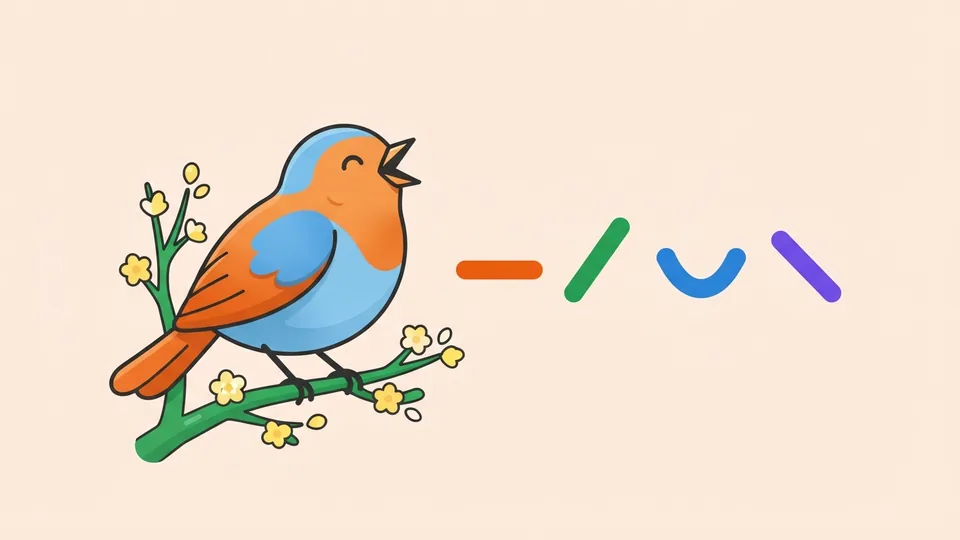
Chinese tones are the melodies a syllable is said with. Mandarin has four of them, plus a fifth, the neutral tone: short and without a melody of its own. The tone is part of the word, much like stress in English, where REcord and reCORD are different words. Say ma high and level and it means "mom"; say it low, with a dip, and it means "horse". That is why Chinese is called a tonal language, and why learning its pronunciation starts with the tones.
What is a tone in Chinese?
A tone is the pitch of your voice and the way it moves within one syllable. It is not loudness and not length: you can whisper a syllable or shout it, and the tone stays the same. The only thing that changes is where your voice goes: it stays high, rises, dips or falls.
Tone is easy to confuse with intonation, because both are melody. The difference is what the melody belongs to. In English, intonation sits on the whole sentence and carries your attitude: the same "yes" can be a question, an agreement or surprise, and the word itself doesn't change. In Chinese, a tone is fixed to each syllable and changes the word itself. Chinese has intonation too, but it doesn't break the tones: the whole sentence sounds higher or lower, while the shape of each syllable is kept. That's why questions are usually asked with a particle at the end rather than with a rising voice.
How many tones are there in Chinese? A chart
Standard Mandarin (Putonghua) has four tones and a light one, also called the neutral or fifth tone. Hence two answers to the same question, "four" and "five", and both are right: it depends on whether you count the neutral tone. Other varieties count differently: Cantonese, for example, is usually said to have six tones. In pinyin, the tone is shown by a mark over the vowel; the neutral tone has no mark. Tap a syllable to hear it:
| Tone | Mark | Pitch movement | Scale | In Chinese | Example |
|---|---|---|---|---|---|
| First | ā | high and level | 5–5 | 一声 yī shēng | |
| Second | á | rising | 3–5 | 二声 èr shēng | |
| Third | ǎ | low, with a dip | 2–1–4 | 三声 sān shēng | |
| Fourth | à | sharply falling | 5–1 | 四声 sì shēng | |
| Neutral (light, fifth) | none | short, no melody of its own | depends on the syllable before | 轻声 qīng shēng |
The lines show how the voice moves: the higher the line, the higher the pitch. The "Scale" column says the same thing in numbers: your voice range is split into five steps, where 1 is the bottom and 5 is the top. The first tone, 5–5, stays at the top; the fourth, 5–1, falls through the whole range. The pitch isn't absolute: everyone's voice is different, and a bass singer's "5" is lower than a child's. What matters is the movement, not the note.
How tones are written in pinyin
The tone mark copies the movement of the voice: a flat bar is level, a stroke up is a rise, a check mark is a dip, a stroke down is a fall. Three rules decide where it goes.
- If the syllable has an a or an e, the mark goes on it: hǎo, xiè, tiān.
- In ou, it goes on the o: gǒu, dōu.
- Otherwise, it goes on the last vowel: liù, duì, guó.
Where marks are awkward to type, the tone is written as a number after the syllable: ma1, ma2, ma3, ma4, and the neutral tone as ma5 or ma0. Dictionaries and keyboard input often do this. Characters don't show the tone at all: you only learn it from pinyin or by ear.
What each tone sounds like
The first tone is high and level, as if you were holding one note: . The most common mistake is starting too low: then it sounds like the third tone.
The second tone rises from the middle to the top, the way you say "What?" when you didn't catch something: .
The third tone is the lowest. Textbooks draw it as "down and up", but in real speech it usually just stays low, without the rise at the end: . If you think of it as the "low" tone, it comes out more easily.
The fourth tone falls from top to bottom, short and firm, like a command: "Stop!" .
The neutral tone is a short syllable with no melody of its own. You'll find it on the second syllable of many words: in the first syllable has the first tone and the second one is neutral. Its pitch adjusts to the syllable before it: after a third tone it sounds a little higher, after a fourth it sits quite low. You don't need to drill it separately: just say the syllable short and unstressed.
Which tone is the hardest?
Most learners stumble on the third: the textbook draws it as a check mark, but in speech it nearly always stays low, and on top of that it changes before another third tone. How it really sounds and how to get it right is in a separate article on the third tone. The second common trouble is the pair of second and third tones: to the ear, both seem to "go up", and only comparing them side by side helps you tell them apart.
Why the tone changes the meaning
Chinese has few syllables, so the same syllable with different tones gives different words. Sometimes opposite ones:
- 买mǎito buythird tone
- 卖màito sellfourth tone
- 四sìfourfourth tone
- 十shítensecond tone
A native speaker will usually understand you even with a wrong tone, from context. But listening to that kind of speech is as tiring for them as English is for you when every word is stressed on the wrong syllable.
Three tone change rules (tone sandhi)
In speech, neighbouring tones affect each other. There are only a few rules, and you meet them in your very first phrases.
- Two third tones in a row. The first one is said as a second tone. is written nǐ hǎo but said "ní hǎo". The mark in pinyin stays as it is.
- 不 before a fourth tone. The negation "not" is bù, fourth tone. But before another fourth tone it rises to a second: .
- 一 before other syllables. The number "one" is yī when you count. Before a fourth tone it is read with the second tone: , and before the others with the fourth: .
How to learn Chinese tones, step by step
You can't learn tones with your eyes: the rules fit on one page, but the skill lives in your ear and your voice. The order is: first learn to hear, then to repeat, then to check yourself.
- Listen in pairs. A tone is easier to hear by contrast: mā and mà, tāng and táng. In the pinyin chart you can play any syllable in all four tones in a row. Until you hear the difference, you won't be able to produce it.
- Exaggerate at first. In the beginning, overdo the tones: the first higher than feels natural, the fourth sharper. In normal speech they'll soften on their own.
- Record yourself. Your own voice sounds different from the inside: you think the tone went up, but the recording is flat. Record a syllable on your phone and play it right after the model; you'll hear the gap the first time.
- Compare with a model. In the pronunciation trainer the melody of your voice is drawn over the speaker's, so you can see where they part.
- Move from syllables to words. A single syllable comes quickly; the trouble starts with pairs, because tones affect each other. Practise two-syllable words and short phrases, not just mā má mǎ mà.
- Learn each word with its tone. A tone isn't decoration, it's part of the word. Memorising "ma means horse" is useless: memorise mǎ.
Hear the tones yourself
The first lesson of the course is The Four Tones: you hear a syllable, pick the melody and see right away if you got it. Five minutes, free.
Take the tones lesson