Chinese word order: the sentence structure
Chinese words have no endings, so a word's role is decided by its place in the sentence. That makes word order the core of Chinese grammar. The good news for English speakers: the backbone is the familiar subject–verb–object. The catch is everything else. English piles time, place and manner at the end of the sentence; Chinese puts them all before the verb. Learn that one scheme and you have most of it: it has almost no exceptions.
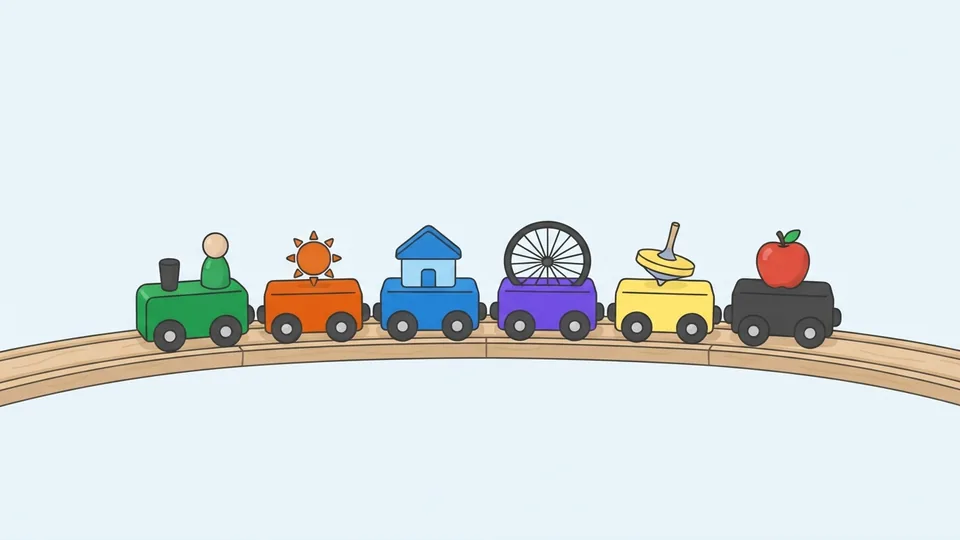
The Chinese sentence structure
- Who: the subject. 我, 他, 妈妈.
- When: a time word. 明天, 每天, 八点.
- Where: a place with 在. 在家, 在公司.
- How, with whom, by what: 跟朋友, 坐地铁.
- The verb: 看, 吃, 学习.
- What: the object. 新闻, 汉语.
A real sentence rarely fills every slot, but the slots it does fill come in this order. Here is one with five: 我 "I", 每天 "every day", 在网上 "online", 看 "read", 新闻 "the news".
- 我每天在网上看新闻wǒměitiānzàiwǎngshangkànxīnwénI read the news online every day.
Compare the two: English says "I read the news online every day", with the circumstances trailing after the object. Chinese says "I every day online read the news". Everything that describes the circumstances of the action comes before the verb. The English order simply can't be built in Chinese.
The backbone: subject, verb, object
Take away the circumstances and you're left with the skeleton: subject, verb, object, exactly as in English. Words don't change form, so swapping them changes the meaning: 我爱你 is "I love you", 你爱我 is "you love me". There's no "me" versus "I" to help you; position is all there is.
- 他们买了新房子tāmenmǎilexīnfángziThey bought a new home.
- 我很喜欢它们wǒhěnxǐhuantāmenI really like them.
Time goes before the verb
The time word comes right after the subject or at the very start of the sentence. Both are correct; at the start, time sounds a little more prominent. After the verb, where English likes it, it never goes.
- 我早上七点起床。wǒzǎoshangqīdiǎnqǐchuángI get up at seven in the morning.
- 晚上我在家看电视wǎnshangwǒzàijiākàndiànshìIn the evening I watch TV at home.
Within the time phrase itself, the order runs from big to small: first the day, then the part of the day, then the hour. English goes the other way ("at three tomorrow afternoon"). How to say hours and dates: see the guide to telling time in Chinese.
- 明天下午三点míngtiānxiàwǔsāndiǎnat three tomorrow afternoon
Place comes after time, and also before the verb
Where the action happens is said with : 在 + place, and only then the verb. If there's both a time and a place, time comes first: first "when", then "where". English does the reverse, "at home in the evening".
- 我在公司工作wǒzàigōngsīgōngzuòI work at a company.
- 我在学校学习汉语wǒzàixuéxiàoxuéxíHànyǔI study Chinese at school.
How, with whom, to whom: also before the verb
The means, the companion and the recipient of an action go right before the verb: "I by subway go", "I with you meet", "I to you call". A companion is introduced by , a recipient by .
- 我坐地铁去上班wǒzuòdìtiěqùshàngbānI take the subway to work.
- 我想跟你见面。wǒxiǎnggēnnǐjiànmiànI’d like to meet with you.
- 我晚上给你打电话。wǒwǎnshanggěinǐdǎdiànhuàI’ll call you in the evening.
Short adverbs sit there too, before the verb: and . In English, "too" usually goes at the very end ("I'm fine too"); in Chinese, 也 goes only right after the subject.
- 我也很好wǒyěhěnhǎoI’m fine too.
- 我们都是学生wǒmendōushìxuéshengWe are all students.
Negation goes before the verb
and 没 go before what they negate: before the verb, or, if there's a "can", "want" or "know how to" in front of it, before that word. That part is just like English "can not", minus the "do": no "don't" or "didn't" needed.
- 我不喝牛奶wǒbùhēniúnǎiI don’t drink milk.
- 我没带钱。wǒméidàiqiánI didn’t bring any money.
- 这儿不能停车zhèrbùnéngtíngchēYou can’t park here.
Questions: the same word order
To ask a question, you don't move any words and you don't add "do". A yes/no question is a statement with the particle 吗 at the end. In other questions, the question word stands where the answer will be: ask about time and it sits in the time slot, ask about place and it sits in the place slot. Nothing jumps to the front the way "what" and "where" do in English.
- 你明天有空吗?nǐmíngtiānyǒukòngmaAre you free tomorrow?
- 你几点起床?nǐjǐdiǎnqǐchuángWhat time do you get up?
- 我们明天在哪儿见面wǒmenmíngtiānzàinǎrjiànmiànWhere shall we meet tomorrow?
Compare the question 你几点起床 with the answer 我早上七点起床: it's the same sentence with one word swapped. The list of question words is in the guide to Chinese pronouns.
Modifiers go before what they describe
Everything that describes a noun goes before it, usually joined with the particle 的: whose, what kind, which. For "whose" and "what kind" that's like English ("my book", "a red car"). But the English relative clause, "the picture that I painted", is built the other way round: "I painted 的 picture".
- 我的书在桌子上wǒdeshūzàizhuōzishangMy book is on the table.
- 这是我画的画。zhèshìwǒhuàdehuàThis is the picture I painted.
What comes after the verb: how long and how many times
"When" goes before the verb, but "for how long" and "how many times" go after it. They are different things: 八点 "at eight" is a point in time, 两年 "two years" is a duration. 我学了两年 means "I studied for two years". Here, for once, Chinese and English agree.
- 我病了三天。wǒbìnglesāntiānI was sick for three days.
- 他在医院住了一个月tāzàiyīyuànzhùleyígeyuèHe spent a month in the hospital.
- 我去过两次。wǒqùguoliǎngcìI’ve been there twice.
- 请再说一遍。qǐngzàishuōyíbiànPlease say it again.
How well an action is done also comes after the verb, with 得: 他跑得非常快 "he runs very fast". More on that in the guide to Chinese particles.
The next step: 把
At HSK 3 you meet a pattern that breaks the usual order. 把 moves the object forward, in front of the verb: subject + 把 + object + verb + result. You use it when what matters is what happened to a particular thing: the door got closed, the phone got broken. After the verb there must always be something: a result, a direction, or at least 了.
- 请把门关上。qǐngbǎménguānshàngPlease close the door.
- 我把手机摔坏了。wǒbǎshǒujīshuāihuàileI dropped my phone and broke it.
Build the sentence yourself
In the lessons you learn word order hands-on: you put the words in place and see your mistake right away. Free during the beta.
Start for free