How to learn Chinese by yourself: choosing self-study material and a first-week plan
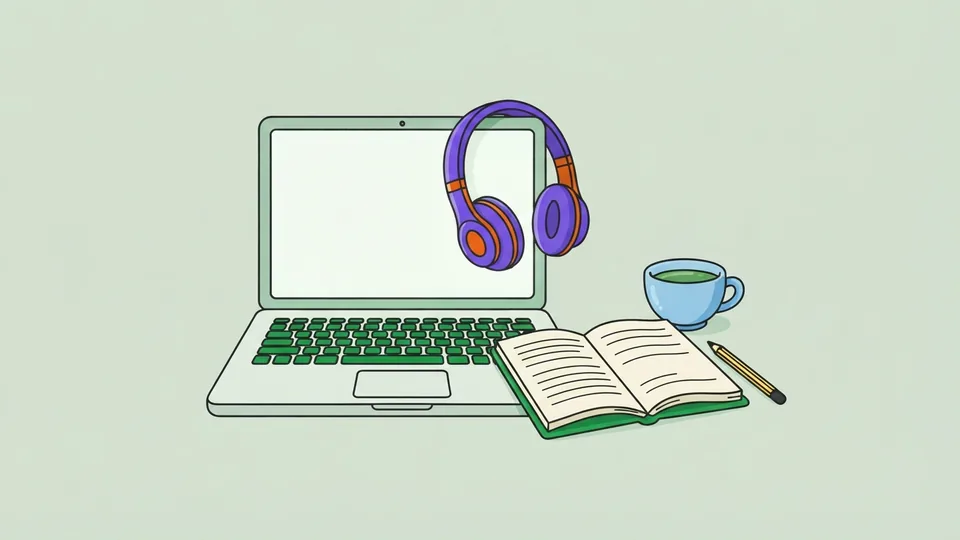
You can learn Chinese by yourself from a book, a PDF, a video series or an online course. The question that decides between them is simple: who tells you when you got something wrong? In Chinese the tone changes the meaning of a word, and characters are written in a set stroke order — and paper can’t check either. That’s why, if you’re starting from zero, an online course that plays every word and checks your answers is the easier way in, with a book kept nearby as a reference. Below: a comparison, a checklist and a plan for your first week.
What a self-study Chinese course needs to do
Chinese has a few features that a typical language textbook never has to deal with. They decide what you need from your study material.
- Audio for every word. A character doesn’t show how it’s read, and pinyin without a recording is easy to read like English: “xie” isn’t “zee”, and “cai” isn’t “kay”. You need to hear each word, and more than once.
- A pronunciation check. A tone is the melody of a syllable. You rarely notice your own tone mistakes by ear until someone shows you.
- A writing check. You can copy a character so it looks right and still write it in the wrong order. Your hand learns the wrong way just as happily as the right one.
- Review on a schedule. A word sticks if you come back to it after a day, after three days, after a week. Few people manage to keep that schedule by hand.
- Instant feedback. An answer checked a minute later fixes the mistake. An answer checked against the key a week later doesn’t.
For the order to learn all this in, see How to start learning Chinese.
Books, PDFs, videos or an online course: how they compare
Print textbooks such as the HSK Standard Course, Integrated Chinese or the New Practical Chinese Reader come with audio and give you a well-planned syllabus. A “free Chinese PDF” is usually the same kind of book without the sound. Video lessons explain things well, but they can’t hear you. Here’s how the formats compare:
| Criterion | Print textbook | Free PDF | Video lessons | Online course |
|---|---|---|---|---|
| Audio for every word | If it comes with audio — as separate tracks | Usually none | Yes, but you can’t replay one word with a tap | Yes, next to every word |
| Pronunciation check | No | No | No | Yes, if it listens through the microphone |
| Writing check | No: there are practice sheets, but nobody sees your mistake | No | No | Yes, if it checks stroke order |
| A set order of lessons | Yes, planned by the authors | Same as the original book | Depends on the creator: some offer a course, some single videos | Yes: one lesson leads to the next |
| Review on a schedule | You keep track yourself | You keep track yourself | You keep track yourself | The program brings words back for you |
| Feedback | Answer key at the back | An answer key, if it made it into the file | None | Right after every answer |
| Cost | One-time purchase | Free | Free or one-time | Varies: free tiers, one-time payments, subscriptions |
Each format has its place. A book is great for detailed grammar explanations, and it’s easy to flip through and write in. A video shows a real person shaping their lips and tongue. Their shared weak spot: they don’t know what you answered. If you want a tutor or a class, that’s no longer self-study — you pay per lesson, but a person corrects your mistakes. More on that in our article on online Chinese classes. And if you’re choosing a book, see HSK textbooks.
How to choose the best way to learn Chinese on your own: a checklist
The best self-study material isn’t the thickest or the most famous one — it’s the one you’ll actually open every day. Before you commit, check seven things.
- Can you hear every word and phrase? Not just “audio for the lesson”, but a way to replay a single word as many times as you need.
- Does it start with pinyin and tones? If page one jumps straight into dialogues, you’ll end up relearning your pronunciation.
- Does anything check your answers? Exercises with an answer key are the minimum. Better if the check happens right away.
- Do you speak out loud and write? You can’t learn Chinese only by reading and tapping multiple-choice answers.
- What syllabus is it built on? The HSK exam has a new standard, HSK 3.0, and its first level is twice the size of the old one.
- What language are the explanations in? Grammar and sounds are easier when they’re explained in your own language and compared with English sounds you already know.
- Can you try it before paying? Do two or three lessons. If after ten minutes you want to keep going, the format suits you.
How Nomto works as a self-study Chinese course
Nomto is an online Chinese course for self-study. It runs in the browser on your phone and computer, so there’s nothing to install. Mei, your tutor, explains everything in English. Here’s what it offers, point by point from the checklist:
- Syllabus. The course follows the levels of the new HSK 3.0 standard: HSK 1–6, 934 lessons, 5,400 words. A lesson takes about ten minutes.
- Audio. Every word and phrase has a recording.
- Lessons. An explanation, word cards, multiple choice, building a sentence, matching pairs, writing a character and a “say it out loud” task with a check.
- Pronunciation. In the Pronunciation section you say a word and see the melody of your voice under the speaker’s, with a tone verdict for each syllable.
- Writing. Writing sheets with a stroke-order check, and a collection of the characters you’ve learned.
- Review. Words come back on a schedule — the program handles spaced repetition for you.
- Trainers. An ear for tones, tones in your own voice, stroke order, characters from meanings, pairs against the clock, cards with your first words.
Who Nomto isn’t for
Self-study is still self-study. Here’s honestly what we don’t have:
- A live teacher. The program checks your tasks, not a person. If you need someone who listens to you and answers your questions, look for a tutor or a school.
- Classes and a timetable. There are no sessions at set times. If you tend to quit without an outside schedule, choose a course with a group.
- A certificate. We don’t issue any completion document; only the HSK exam itself gives you a certificate.
- A course for children. The lessons are written for teens and adults.
For practice in the real exam format there’s a timed HSK mock test with listening and reading.
Learn Chinese for free: what’s open
The trainers and the first section of HSK 1 work without even signing up. The reference pages are open too: the pinyin chart with audio, HSK 1 words and the other levels, mini-tests, writing sheets and articles. That’s enough to get through the first week of the plan below and see whether the format works for you.
Chinese for beginners: a first-week self-study plan
The plan takes 15–20 minutes a day. It works with any self-study material that has audio.
- Days 1–3. Pinyin and tones. Learn how syllables are read and how to tell the four tones apart. The same syllable with a different melody is a different word: . Listen and repeat out loud. How tones work is covered in our article on tones.
- Days 4–5. Your first words. Take a few words and work on each until you recognize it by ear and say it with the right tone. Write each one in the correct stroke order.
- Days 6–7. Your first sentences. Build a sentence from words you know, then swap one word. The basic word order is the same as in English: who, does what, to what.
- 你好nǐhǎohello
- 谢谢xièxiethank you
- 我wǒI, me
- 学生xuéshengstudent
- 我是学生wǒshìxuéshengI’m a student
By the end of the week you can read pinyin, hear the tones, say hello and say who you are. You’ll also get a feel for how hard it really is — there’s a separate article on that: Is Chinese hard to learn?
Try self-study in practice
The trainers and the first section of HSK 1 work without signing up; during the beta the whole course is free with an account.
Start for free