IELTS · Guias · 30 de outubro de 2026 · 4 min de leitura
IELTS Speaking Part 3: como responder perguntas abstratas, com exemplos e frases úteis
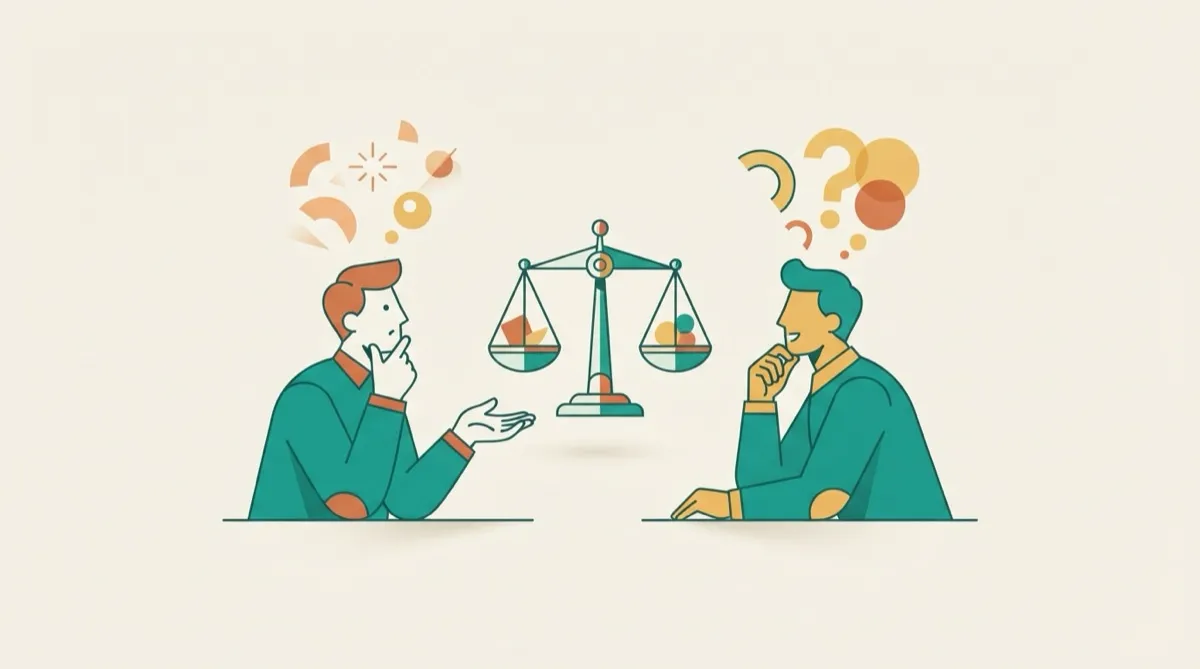
A Part 3 do IELTS Speaking dura 4 a 5 minutos e é uma discussão sobre o tema do cartão da Part 2, mas em nível geral: sociedade, mudanças, comparações, futuro. Não perguntam mais da sua vida, e sim “Why do people…?”, “How has… changed?”, “Should the government…?”. A resposta boa tem 4 a 6 frases: opinião, motivo, exemplo e uma ressalva.
Como a Part 3 se liga à Part 2
| Cartão da Part 2 | Perguntas da Part 3 |
|---|---|
| Describe a useful app on your phone | How has technology changed the way people communicate? Do older people find it harder to use new technology? |
| Describe a city you visited | Why do young people move to big cities? What problems do large cities face? |
| Describe a person you admire | What qualities make a good role model? Do celebrities have a responsibility to set an example? |
É a parte que mais separa 6.0 de 7.0, porque exige ideias abstratas, comparações e hipóteses, e não só vocabulário do dia a dia.
A estrutura em quatro passos
- Opinião direta: I think…, In my view…
- Motivo: mainly because…
- Exemplo concreto, de preferência do Brasil: In Brazil, for example,…
- Ressalva ou outro lado: That said,…, On the other hand,…
Why do young people move to big cities? I’d say the main reason is work. Most of the well-paid jobs, especially in technology and finance, are concentrated in a few places. In Brazil, for example, a lot of people from the Northeast still move to São Paulo, because companies there pay more and there are more opportunities to grow. That said, I think this is starting to change. Since the pandemic, many companies have allowed remote work, so some people are moving back to smaller cities where life is cheaper.
Should the government limit the use of cars in city centres? To some extent, yes. Traffic in cities like São Paulo is so bad that people spend two or three hours a day commuting, and that has a huge impact on health and productivity. But I don’t think simply banning cars would work unless public transport improves first. If the metro reached more neighbourhoods, people would leave their cars at home voluntarily.
Repare nos recursos que contam para a nota: comparação (cheaper, more opportunities), condicional (If the metro reached…, people would…), present perfect (have allowed) e conectores.
Frases úteis
| Função | Frases |
|---|---|
| Opinar | I’d say… · I tend to think… · From my point of view… |
| Ganhar tempo | That’s not something I’ve thought about much, but… · Let me think… |
| Comparar | Compared to my parents’ generation,… · …whereas… |
| Generalizar com cuidado | In general,… · Most people, I think,… · It depends on… |
| Especular sobre o futuro | I imagine that… · It’s likely that… · In twenty years’ time,… |
| Concordar em parte | Up to a point… · That’s partly true, but… |
Erros comuns de brasileiros
- Respostas curtas demais, como na Part 1. Aqui o examinador quer desenvolvimento. Se você parou em duas frases, acrescente um exemplo.
- “Is” sem sujeito: “Is important to have rules” → “It’s important to have rules”.
- “The people” para pessoas em geral: “The people prefer apps” → “People prefer apps”. Generalizações em inglês vêm sem artigo: technology, young people, society.
- “Since the pandemic, people work from home” → “Since the pandemic, people have been working from home”.
- “Actually” no sentido de “atualmente”: “Actually, cities are more violent”. Use nowadays ou these days.
- “Make sport”, “make a research” → do sport, do research (sem a).
Quando você não sabe nada do assunto
Ninguém espera conhecimento técnico. Admita e raciocine em voz alta: “I’m not an expert on this, but I imagine that…”. O critério é a língua, não a precisão dos fatos. Ficar em silêncio é que prejudica a Fluency.
Como treinar
- Escolha um cartão da Part 2 e escreva três perguntas “por quê” e “como mudou” sobre o tema. Responda cada uma em 40 segundos.
- Grave e conte as estruturas: teve comparação? Condicional? Exemplo?
- Vocabulário por tema em vocabulário para o IELTS; temas frequentes em temas do IELTS Speaking.
Formato conforme ielts.org, conferido em 30 de outubro de 2026.
Pratique agora
Na sala de prática da Nomto você responde às perguntas da Part 3 em voz alta e recebe nota pelos critérios do IELTS. Comece por tecnologia, cidades ou role models.
Outros idiomas: Oʻzbekcha, العربية, Bahasa Indonesia, Türkçe, Tiếng Việt, English, Español, Русский