Spoken English · Guides · October 30, 2026 · 7 min read
English for travel: phrases for the airport, hotel, restaurant and getting around
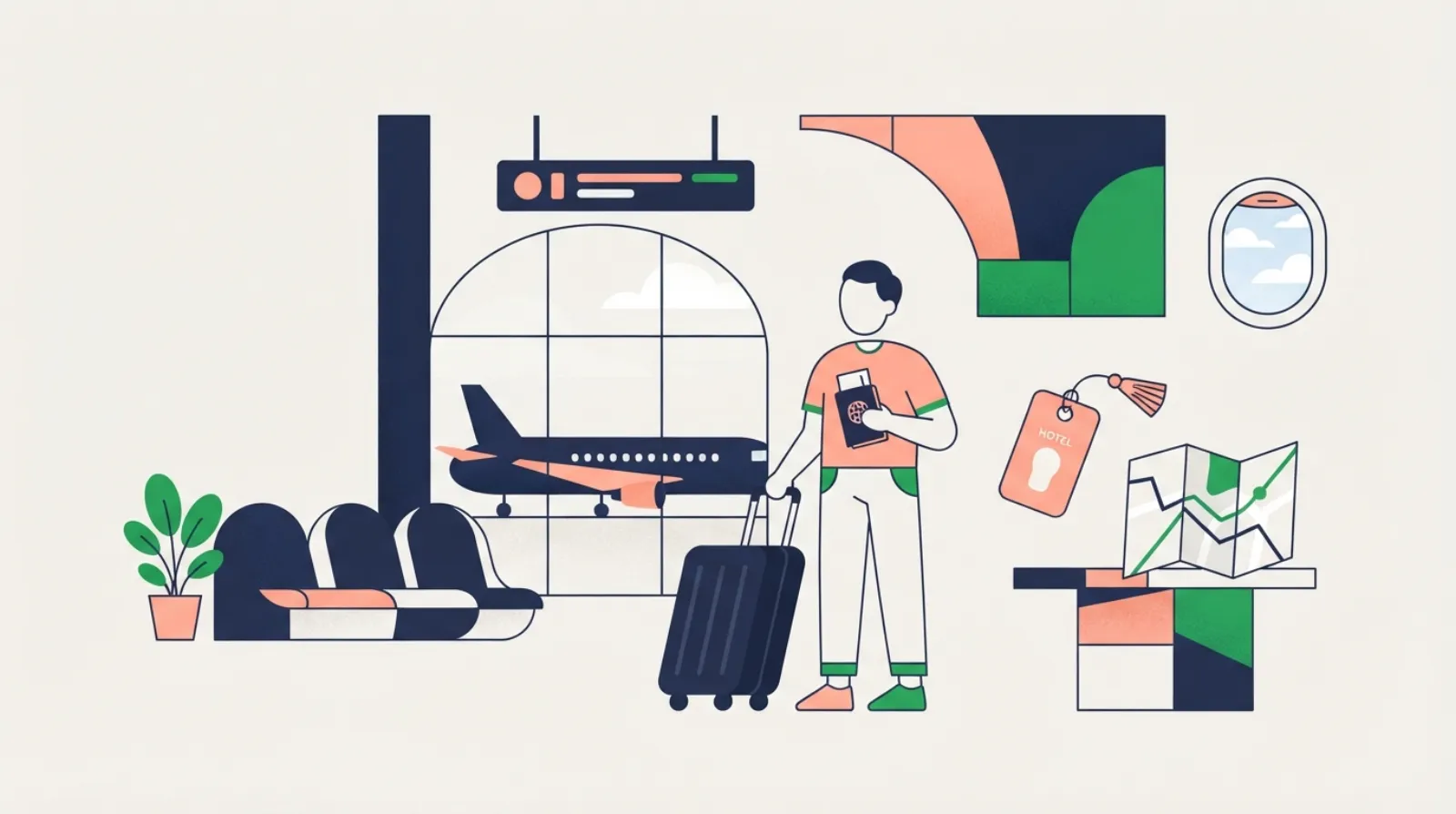
English for travel is a small set of phrases you can learn in a few days: how to check in, get through passport control, ask for your hotel room, order food, take a taxi and ask for directions. You don’t need perfect grammar. You need polite questions (Could I…?, Where is…?, How much is…?) and the confidence to say them out loud. Below are the phrases travellers use most, grouped in the order of a real trip, with short dialogues and the questions staff are likely to ask you.
Tip: the most useful word on any trip is please, and the most useful structure is Could I have…, please? With it you can order a coffee, a ticket or a room key.
At the airport
Check-in
- I’d like to check in for my flight to Lisbon.
- Here’s my passport.
- Can I have a window seat, please? / An aisle seat, please.
- I have one bag to check in.
- Can I take this as hand luggage?
- What time does boarding start?
- Which gate is it?
Questions you will hear:
- Where are you flying to today?
- Did you pack your bag yourself?
- Are you carrying any liquids or sharp items?
- Could you put your bag on the scale, please?
- Your bag is two kilos over the limit.
Dialogue: checking in
Agent: Good morning. Where are you flying to today?
You: Good morning. To Barcelona.
Agent: Can I see your passport, please?
You: Here you are.
Agent: Thank you. Any bags to check in?
You: Just this one. Could I have an aisle seat, please?
Agent: Of course. Here’s your boarding pass. You’re in seat 14C. Boarding starts at 9:40 from gate B12.
You: Great, thank you.
Security
- Do I need to take my laptop out?
- Should I take off my shoes?
- Sorry, I forgot I had water in my bag.
On the plane
- Excuse me, I think you’re in my seat.
- Could I have some water, please?
- Can I have the chicken, please?
- Could you help me with my bag?
- How long is the flight?
Passport control and customs
Questions you will hear:
- What’s the purpose of your visit? — I’m here on holiday. / For business. / To visit friends.
- How long are you staying? — For ten days.
- Where are you staying? — At the Park Hotel in the city centre.
- Do you have anything to declare? — No, nothing.
Answer short and clearly. You don’t need full sentences here: Ten days is fine.
Problems at the airport
- My flight has been delayed. When is the next one?
- I’ve missed my connection.
- My luggage hasn’t arrived.
- My suitcase is damaged.
- Where is the lost luggage desk?
At the hotel
Checking in
- Hi, I have a reservation under the name García.
- I booked a double room for three nights.
- What time is breakfast?
- Is Wi-Fi included? What’s the password?
- What time is check-out?
- Could I leave my luggage here until the evening?
Dialogue: hotel check-in
Receptionist: Good evening. How can I help you?
You: Hi, I have a reservation under the name Silva.
Receptionist: Let me check… Yes, a double room for three nights. Could I see your passport?
You: Sure. Is it possible to have a room with a view?
Receptionist: I have one on the sixth floor with a sea view. There’s a small extra charge of 15 euros a night.
You: That’s fine. What time is breakfast?
Receptionist: From seven to ten in the restaurant downstairs. Here’s your key card. Room 612.
You: Thanks a lot.
Problems in the room
- The air conditioning isn’t working.
- There’s no hot water.
- Could I have some extra towels, please?
- The room is a bit noisy. Is it possible to change rooms?
- Could you call a taxi for me, please?
At a restaurant or café
Getting a table and ordering
- A table for two, please.
- Do you have a table by the window?
- Could we see the menu, please?
- What do you recommend?
- I’ll have the soup, please.
- Could I have it without onions?
- I’m allergic to nuts. Does this dish have nuts in it?
- Is this dish spicy?
During the meal and paying
- Excuse me, could we have some more bread?
- This isn’t what I ordered.
- Could we have the bill, please? (UK) / Could we get the check, please? (US)
- Can I pay by card?
- Is service included?
- Keep the change.
Getting around
Taxi
- Could you take me to this address, please?
- How much will it cost to the airport?
- Could you stop here, please?
- Can I pay by card?
Bus, train and metro
- Where can I buy a ticket?
- A single to Oxford, please. / A return to Oxford, please.
- Does this bus go to the city centre?
- How many stops is it to the museum?
- Which platform does the train to Milan leave from?
- Is this seat free?
Asking for directions
- Excuse me, how do I get to the station?
- Is it far from here?
- Can I walk there?
- Could you show me on the map?
Answers you will hear:
- Go straight on for about 200 metres.
- Turn left at the traffic lights.
- It’s on your right, next to the bank.
- Take the second street on the left.
- It’s about a ten-minute walk.
Dialogue: asking the way
You: Excuse me, could you tell me how to get to the old town?
Local: Sure. Go straight down this street, then turn right at the church.
You: Turn right at the church. OK.
Local: Then keep going for about five minutes. You’ll see the main square.
You: Is it far?
Local: Not really, about ten minutes on foot.
You: Great, thanks for your help!
Shopping
- How much is this?
- Do you have this in a smaller size? / in blue?
- Can I try it on?
- I’m just looking, thanks.
- Could I get a receipt, please?
- Can I get a tax refund on this?
Emergencies
- Help!
- Please call an ambulance.
- I need a doctor.
- I’ve lost my passport.
- My wallet has been stolen.
- Where is the nearest pharmacy?
- Where is the police station?
Common mistakes
- “Give me…” sounds rude in English. Say Could I have…, please?
- “I want a coffee” is understood but sounds abrupt. I’d like a coffee or Can I get a coffee? is more natural.
- “Where is the toilet?” is fine, but Where’s the restroom? (US) or Where are the toilets? (UK) sounds more natural.
- “I have a reservation on the name…” Say under the name.
- “How much costs it?” Say How much is it? or How much does it cost?
- Forgetting “Excuse me” before stopping a stranger in the street.
Practise before you go
The phrases above are easy to read and surprisingly hard to say when a tired check-in agent is waiting. Rehearse the situations out loud before the trip:
- Read one dialogue, playing both roles.
- Change the details: your destination, your name, a different problem.
- Close the text and act out the scene from memory.
- Practise with a partner who asks unexpected questions.
The conversation linked below this article opens the At the airport room on Nomto: Nomi plays the check-in agent, you check in and find out your gate, and after every reply you see a corrected and more natural version. Nomto also has rooms for the hotel, restaurant, taxi and asking for directions. For more ready lines, see daily use English sentences and greetings in English.
FAQ
What English do I need to travel?
At A2 level you can handle most travel situations with ready phrases. The key is polite questions and understanding the most common answers.
How do I ask someone to repeat something?
Sorry, could you say that again? or Could you speak more slowly, please? Staff in airports and hotels are used to this.
Should I use British or American English when travelling?
Either is fine. A few words differ (bill / check, lift / elevator, return ticket / round-trip ticket), but people will understand you.
How can I remember travel phrases?
Learn them in situations, not as a list, and say them out loud several times. Acting out a full scene, like hotel check-in, works better than memorising single lines.
Also in Español, Bahasa Indonesia, Português (Brasil), Русский, Türkçe, Tiếng Việt