Spoken English · Guides · October 30, 2026 · 12 min read
English tenses chart: all 12 tenses with examples and when to use them
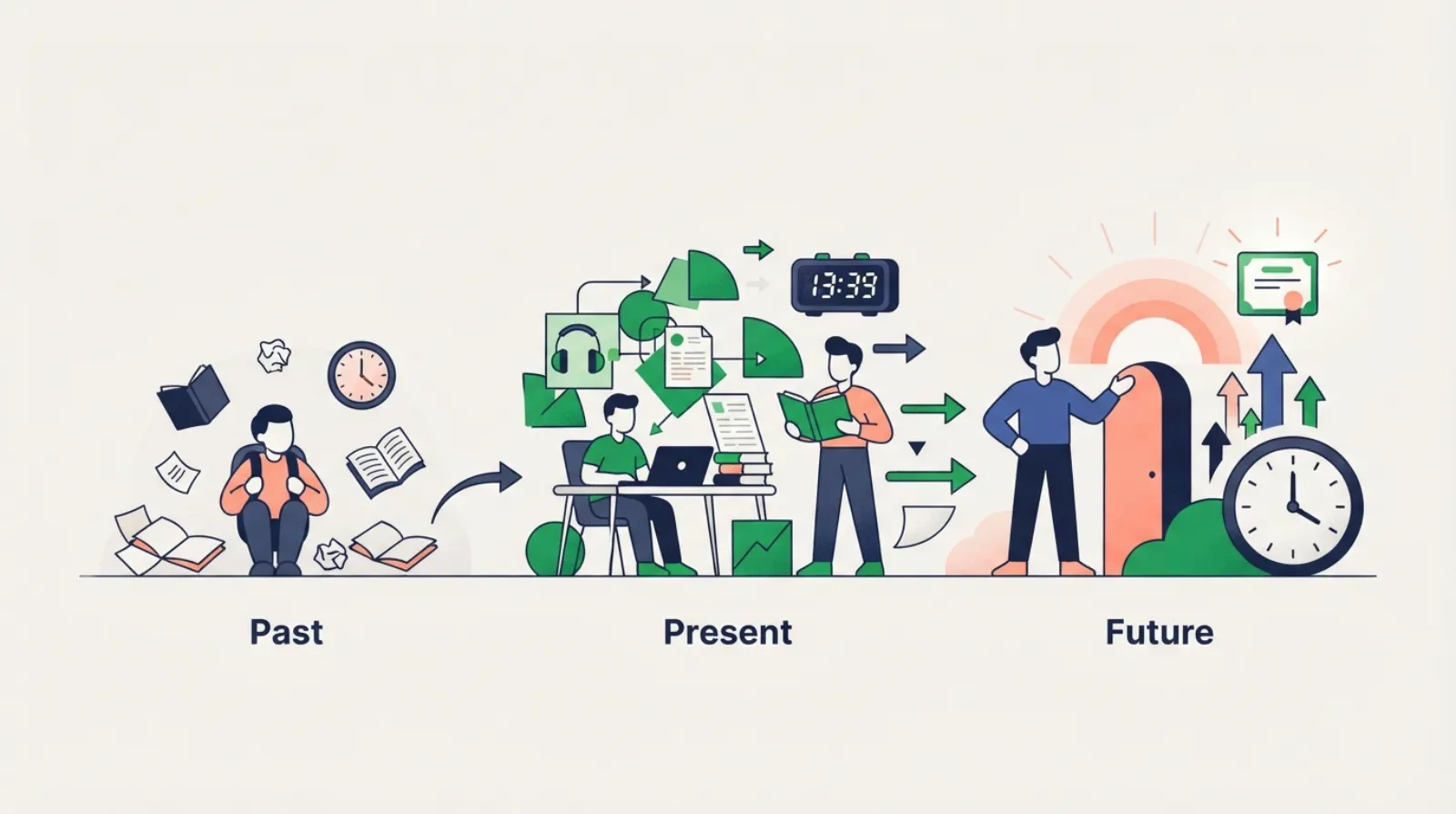
English has 12 tenses: three times (past, present, future) multiplied by four aspects (simple, continuous, perfect, perfect continuous). The simple tenses describe facts, habits and finished events; the continuous tenses describe actions in progress; the perfect tenses connect two moments in time; and the perfect continuous tenses describe an action that has been going on for some time up to a moment. Below is an English tenses chart with the form of every tense, clear rules for when to use it and plenty of examples. If you only have time for a few, start with the five tenses in the section “The tenses you need most”.
The English tenses chart
All examples use the verb work.
| Past | Present | Future | |
|---|---|---|---|
| Simple | I worked | I work | I will work |
| Continuous | I was working | I am working | I will be working |
| Perfect | I had worked | I have worked | I will have worked |
| Perfect continuous | I had been working | I have been working | I will have been working |
Read the chart in two directions:
- Across a row, the idea stays the same and only the time changes. Continuous always means “in progress”: was working, am working, will be working.
- Down a column, the time stays the same and the idea changes. In the present column: a habit (I work), right now (I am working), a result (I have worked), a duration (I have been working).
How the forms are built
Every tense is a small formula. Learn the formula once and it works for every verb.
| Aspect | Formula | Example |
|---|---|---|
| Simple | verb (+ -s, + -ed) or will + verb | she works, she worked, she will work |
| Continuous | be + verb-ing | she is working |
| Perfect | have + past participle (V3) | she has worked |
| Perfect continuous | have been + verb-ing | she has been working |
For irregular verbs, the past simple and the past participle have their own forms (go – went – gone). See the irregular verbs list for the 100 most common ones.
Present tenses
Present simple
Form: I/you/we/they work, he/she/it works. Questions and negatives with do/does: Do you work? She doesn’t work.
Use it for:
- habits and routines: I get up at seven. She goes to the gym on Mondays.
- facts and things that are always true: Water boils at 100 degrees. The shop opens at nine.
- timetables: The train leaves at 6:15.
Signal words: always, usually, often, sometimes, never, every day, on Mondays.
Where do you live? – I live in Lisbon, but I work in a town nearby.
Present continuous
Form: am/is/are + verb-ing: I’m working, he’s working, they’re working.
Use it for:
- actions happening now: Sorry, I can’t talk, I’m driving.
- temporary situations: I’m staying with my sister this month.
- plans and arrangements for the future: We’re meeting Anna on Friday.
- changes in progress: Prices are going up. Your English is getting better.
Signal words: now, right now, at the moment, today, this week, currently.
What are you doing? – I’m cooking dinner. Are you coming over later?
Present perfect
Form: have/has + V3: I’ve worked, she’s finished, they haven’t seen.
Use it for:
- life experience, with no specific time: I’ve been to Japan twice. Have you ever tried sushi?
- a past action with a result now: I’ve lost my keys (I can’t open the door now).
- recent news: Look, it’s stopped raining.
- a situation that started in the past and continues now (with for and since): We’ve known each other for ten years. She’s lived here since 2020.
Signal words: ever, never, already, yet, just, so far, recently, for, since.
Have you finished the report yet? – Not yet, but I’ve done most of it.
The key rule: no finished time words with the present perfect. Yesterday, last week, in 2019, two days ago need the past simple.
- I’ve seen that film. (experience, when doesn’t matter)
- I saw that film last week. (a specific finished time)
Present perfect continuous
Form: have/has been + verb-ing: I’ve been working, it’s been raining.
Use it for:
- an action that started in the past and is still going on, when you focus on how long: I’ve been learning English for three years.
- a recent activity that explains a present situation: Your eyes are red. Have you been crying? / I’m tired because I’ve been running.
Signal words: for, since, how long, all day, lately, recently.
How long have you been waiting? – I’ve been waiting for about twenty minutes.
Present perfect or present perfect continuous? The perfect focuses on the result or the number; the continuous focuses on the activity and its duration.
- I’ve written three emails this morning. (result, a number)
- I’ve been writing emails all morning. (activity, duration)
Past tenses
Past simple
Form: regular verbs + -ed (worked, played); irregular verbs have their own form (went, saw, bought). Questions and negatives with did + base form: Did you go? I didn’t see it.
Use it for:
- finished actions at a specific time in the past: I moved to Madrid in 2021.
- a sequence of events in a story: She opened the door, turned on the light and screamed.
- past habits: As a child, I walked to school every day.
Signal words: yesterday, last night, last year, two days ago, in 2015, when I was a child.
What did you do at the weekend? – I went to the beach and met some old friends.
Past continuous
Form: was/were + verb-ing: I was working, they were sleeping.
Use it for:
- an action in progress at a moment in the past: At 8 p.m. yesterday I was having dinner.
- a longer background action interrupted by a short one (past simple): I was walking home when it started to rain.
- two actions in progress at the same time: While I was cooking, my son was doing his homework.
- the background of a story: The sun was shining and birds were singing.
Signal words: while, when, at that moment, at 6 o’clock yesterday, all evening.
What were you doing when I called? – I was taking a shower, sorry.
Past perfect
Form: had + V3: I had worked, she had left.
Use it for: an action that happened before another past action. It is the “past of the past”.
- When we arrived at the station, the train had already left. (first the train left, then we arrived)
- I had never seen snow before I moved to Canada.
- She was nervous because she hadn’t flown before.
Signal words: already, before, by the time, after, never … before.
Had you met him before the party? – No, it was the first time.
You don’t need the past perfect when the order is already clear from the words before or after: I had breakfast before I left is fine.
Past perfect continuous
Form: had been + verb-ing: I had been working, it had been raining.
Use it for: an action that continued for some time up to a moment in the past.
- I had been waiting for an hour when the bus finally came.
- The ground was wet because it had been raining all night.
- She was tired because she had been working since 6 a.m.
Signal words: for, since, how long, all day, before.
This tense is less common in conversation. You will meet it more in stories and books.
Future tenses
Future simple (will)
Form: will + base form: I’ll work, she won’t come.
Use it for:
- decisions made at the moment of speaking: It’s cold in here. I’ll close the window.
- predictions based on opinion: I think you’ll love this film.
- promises, offers and requests: I’ll call you tonight. Will you help me with this box?
- facts about the future: I’ll be 30 next month.
Signal words: tomorrow, next week, soon, I think, probably, I’m sure.
I don’t have any cash. – Don’t worry, I’ll pay.
Future continuous
Form: will be + verb-ing: I’ll be working, they’ll be travelling.
Use it for:
- an action in progress at a moment in the future: This time tomorrow I’ll be flying to Rome.
- polite questions about someone’s plans: Will you be using the car tonight?
Don’t call me at nine, I’ll be having a meeting.
Future perfect
Form: will have + V3: I’ll have finished, they’ll have left.
Use it for: an action that will be complete before a moment in the future.
- I’ll have finished the project by Friday.
- By the time you get here, we’ll have eaten all the pizza.
- By 2030, she will have worked here for 15 years.
Signal words: by, by then, by the time, before.
Future perfect continuous
Form: will have been + verb-ing.
Use it for: how long an action will have continued at a moment in the future.
- In June, I’ll have been living here for five years.
- By the time she retires, she will have been teaching for 40 years.
This is the rarest of the 12 tenses. It is good to recognise it, but you can speak excellent English without using it.
Other ways to talk about the future
The future simple is not the only way to talk about the future. In everyday speech, two other forms are just as common.
| Form | Use | Example |
|---|---|---|
| be going to + verb | plans and intentions decided before now | I’m going to study medicine. |
| be going to + verb | predictions based on what you see now | Look at those clouds. It’s going to rain. |
| present continuous | fixed arrangements with a time and place | I’m seeing the dentist at 4 tomorrow. |
| present simple | timetables and schedules | The film starts at 8. |
Compare a decision made now with a plan made earlier:
- Oh, we’re out of milk. I’ll buy some. (decided now)
- I’m going to buy a new laptop next month. (already planned)
The tenses you need most
You don’t need all 12 tenses equally. In everyday conversation, these five cover most of what people say:
- Present simple: your life, habits and facts. I work in marketing. I usually cook at home.
- Present continuous: what is happening now and your arrangements. I’m reading a great book. I’m meeting a friend tonight.
- Past simple: stories and finished events. I went to Berlin last summer. It was amazing.
- Present perfect: experience and recent news. I’ve never tried surfing. I’ve just got a new job.
- Future with will and going to: plans, decisions and predictions. I’m going to take a course. I’ll send you the link.
Next come the past continuous (for the background of stories) and the present perfect continuous (for how long). The other five tenses are useful to recognise and appear more in writing.
Common mistakes with tenses
Each mistake below shows the wrong version, the correct version and the reason.
I am working here since 2020.→ I have been working here since 2020. Why: for a situation that started in the past and continues now, English uses the present perfect (continuous), not the present.I have seen him yesterday.→ I saw him yesterday. Why: yesterday is a finished time, so you need the past simple.She work in a bank.→ She works in a bank. Why: in the present simple, he/she/it takes -s.Did you went to the party?→ Did you go to the party? Why: after did, use the base form. The past is already in did.I am knowing the answer.→ I know the answer. Why: state verbs (know, like, want, need, believe, understand, own) are not normally used in the continuous.When I will arrive, I will call you.→ When I arrive, I will call you. Why: after when, if, as soon as, before, after about the future, use the present simple.She doesn’t likes coffee.→ She doesn’t like coffee. Why: after doesn’t (and does in questions), the verb loses its -s. The -s is already in does.How long are you living here?→ How long have you been living here? Why: How long about a situation up to now needs the present perfect (continuous).I’m going to call you when I will finish.→ I’m going to call you when I finish. Why: the same rule as above. After when, use the present simple even when you mean the future.Yesterday I go to the shop.→ Yesterday I went to the shop. Why: many learners use the present for everything when they speak fast. Words like yesterday are your signal to switch to the past.
How to remember the tenses
- Learn the logic, not 12 separate rules. Simple = fact or completed event, continuous = in progress, perfect = connection between two times, perfect continuous = duration up to a point.
- Link each tense to a question. What do you do? (present simple) What are you doing? (present continuous) Have you ever…? (present perfect) What did you do last weekend? (past simple) How long have you been…? (present perfect continuous).
- Use the tenses about your own life. Example sentences about yourself are much easier to remember than sentences about “John”.
- Speak, don’t only read. Choosing a tense on paper takes ten seconds; in conversation you have half a second. Only speaking practice closes that gap.
For more sentences you can reuse every day, see daily use English sentences.
FAQ
How many tenses are there in English?
Traditionally 12: past, present and future, each in four forms (simple, continuous, perfect, perfect continuous). Strictly speaking, linguists say English has only two tenses (present and past), and the future is formed with helpers like will, but for learning purposes the 12-tense chart is the most useful map.
Which English tenses are used most often?
The present simple, past simple, present continuous, present perfect and the future with will and going to. Together they cover the vast majority of everyday speech.
What is the difference between “I did” and “I have done”?
I did (past simple) is about a finished time: I did my homework last night. I have done (present perfect) connects the past to now, with no specific time: I’ve done my homework, so I can go out.
Is “continuous” the same as “progressive”?
Yes. Some books say “present progressive”, others say “present continuous”. They are two names for the same tense.
Can I speak English well without the perfect continuous tenses?
Yes. The present perfect continuous is useful (I’ve been waiting for ages), but the past and future perfect continuous are rare in conversation. Focus on the five main tenses first.
Practise the tenses out loud
Knowing the chart is the first step; the real test is choosing the right tense in the middle of a conversation. In the conversation linked below this article, you can talk freely with Nomi in Nomto about anything: your week, your plans, a trip you took. That naturally mixes the past, present and future. When you say I have seen him yesterday or I am living here since 2020, Nomi corrects it right away and shows you the natural version. The most common tense choice in speech has its own guide: present perfect vs past simple.
Try these three questions to start:
- What did you do last weekend? (past simple)
- Have you ever been abroad? Where? (present perfect, then past simple for the details)
- What are you going to do next year? (future with going to)
Also in Español, Bahasa Indonesia, Português (Brasil), Русский, Türkçe, Tiếng Việt